












Video
Extensibility Full Motion Video Management
How do you protect everyone a camera records? Data Harbor blurs people and vehicles, encrypts the originals, and unlocks each type only as policy allows.
Read transcript Hide transcript
Network connected security technology can give investigators valuable leads after a crime.
But that value comes with a hard question. How do you ensure privacy is enforced for every person and vehicle a camera records? This concept shows how developers can use Virtru's toolkit to extend data centric security into the video itself.
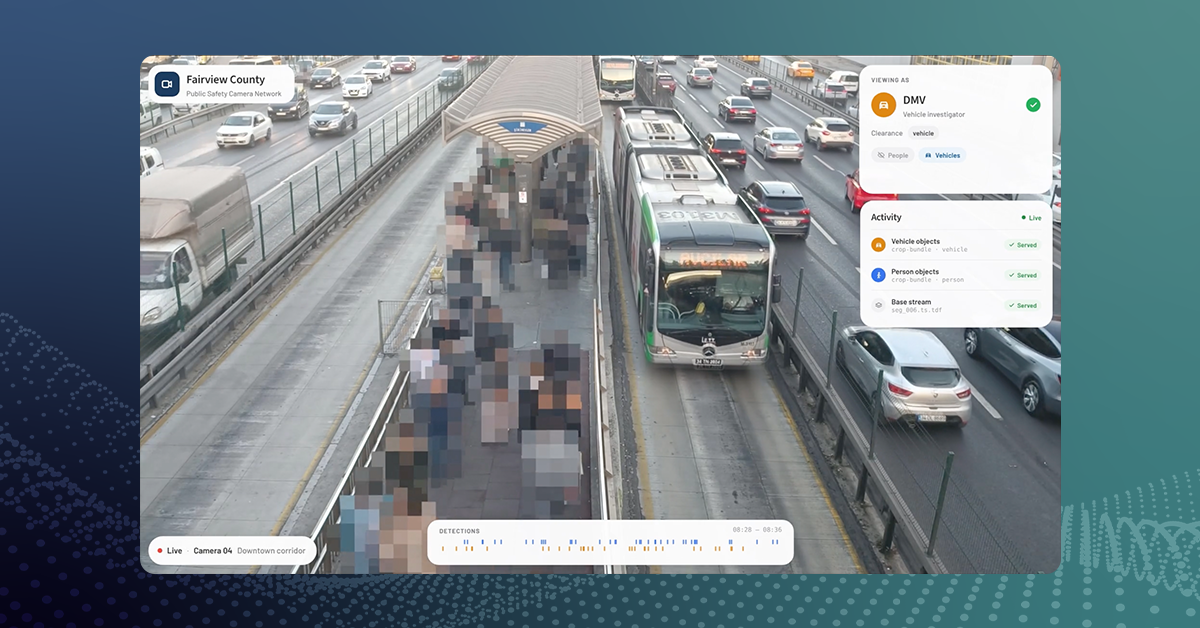
The camera system detects people and vehicles as usual. Each one is blurred directly in the frame, and that blurred base stream is wrapped in the open trusted data format. The original pixels are encrypted separately, with policy set by object type, people or vehicles. If a viewer isn't entitled to people or vehicles, the application shows only blurred video. The original pixels stay encrypted, so everything remains obscured. Privacy is the default state, enforced at the data level.
Entitlement to an object type unlocks that type, and only that type. The video still gives context, while people and vehicles stay private until policy says otherwise. Imagine police are investigating a suspect on foot at a specific place and time.
Using the metadata, they narrow the request to the relevant video window. Their entitlement covers people only, so the application decrypts the person objects in that window and restores them over the blur. All people become visible, not just the suspect, while vehicles stay obscured, and the request is logged. For a stolen car investigation, the entitlement changes, not the video. There's no second copy and nothing to re encrypt. The vehicle investigator sees all vehicles, while people stay protected.
The Data Harbor platform enforces that separation every time protected data is requested. Each request produces a reviewable, served, denied event. In a production workflow, human and agent identities can be entitled independently, so each one reaches only the object types it's allowed to, with an auditable record. Access can also be tied to a case, a purpose, and the minimum necessary time window. One shared stream keeps its investigative value, while privacy stays the default, enforced by encryption and attribute based policy, not by who manages the camera feed.
But that value comes with a hard question. How do you ensure privacy is enforced for every person and vehicle a camera records? This concept shows how developers can use Virtru's toolkit to extend data centric security into the video itself.
The camera system detects people and vehicles as usual. Each one is blurred directly in the frame, and that blurred base stream is wrapped in the open trusted data format. The original pixels are encrypted separately, with policy set by object type, people or vehicles. If a viewer isn't entitled to people or vehicles, the application shows only blurred video. The original pixels stay encrypted, so everything remains obscured. Privacy is the default state, enforced at the data level.
Entitlement to an object type unlocks that type, and only that type. The video still gives context, while people and vehicles stay private until policy says otherwise. Imagine police are investigating a suspect on foot at a specific place and time.
Using the metadata, they narrow the request to the relevant video window. Their entitlement covers people only, so the application decrypts the person objects in that window and restores them over the blur. All people become visible, not just the suspect, while vehicles stay obscured, and the request is logged. For a stolen car investigation, the entitlement changes, not the video. There's no second copy and nothing to re encrypt. The vehicle investigator sees all vehicles, while people stay protected.
The Data Harbor platform enforces that separation every time protected data is requested. Each request produces a reviewable, served, denied event. In a production workflow, human and agent identities can be entitled independently, so each one reaches only the object types it's allowed to, with an auditable record. Access can also be tied to a case, a purpose, and the minimum necessary time window. One shared stream keeps its investigative value, while privacy stays the default, enforced by encryption and attribute based policy, not by who manages the camera feed.
Related Resources
Get expert insights on how to address your data protection challenges
/2026%20Video%20Resources/FMV-final.webp)
November 18, 2026
Extensibility Full Motion Video Management
/2026%20Video%20Resources/calder-bay-financial.webp)
November 18, 2026
Agentic Governance: Letting the Data, Not the Agent, Decide Who Sees What

/video%20-%20booz%20allen%20billington/Virtru%20+%20Booz%20Allen.webp)
September 17, 2026
The Great Inversion: When Zero Trust Finally Reaches the Data | Booz Allen + Virtru
August 10, 2026
Virtru Platform Demo: ABAC for Outlook, SharePoint, and Beyond
July 28, 2026
Zero Trust File Sharing with Virtru Data Harbor

July 28, 2026
The Virtru Platform: Extensible Security and SDKs for Mission Apps
June 29, 2026
How It Works: Virtru Collaborate
June 15, 2026
Virtru Collaborate: Eliminate the Tradeoff Between Compliance and Collaboration

May 19, 2026
Introducing Virtru Collaborate
May 1, 2026
Virtru Collaborate: Securely Store, Organize, and Share Sensitive Files
March 1, 2026
Google E2EE vs. Virtru for Gmail: Sender and Recipient Experience

October 20, 2025
Virtru Data Harbor Platform: Email Workflows
Book a Demo
Become a Partner
Contact us to learn more about our partnership opportunities.
Become a Compliance Champion
Contact us to learn more about our partnership opportunities.