







<img src="https://ad.doubleclick.net/ddm/activity/src=11631230;type=pagevw0;cat=pw_allpg;dc_lat=;dc_rdid=;tag_for_child_directed_treatment=;tfua=;npa=;gdpr=${GDPR};gdpr_consent=${GDPR_CONSENT_755};ord=1;num=1?" width="1" height="1" alt="">
Video

Operation Highmast: Allied Data Sharing with Sir Jim Hockenhull + Andrew Garner | Virtru Data Harbor
Perimeter security stops at the boundary. Hear how Sir Jim Hockenhull and Andrew Garner use Virtru’s TDF to protect data and speed multinational operations.

Read transcript Hide transcript

SIR JIM HOCKENHULL:

I decided fairly early on that I was going to join the army. 40-plus year career, 10 years of operations, then the opportunity to go and do something else.

ANDREW GARNER:

I lead a team of architects and engineers in support of the capability development effort at UK CSOC. Interoperability, zero trust, data-centric security have been particular focus areas over the last five or six years. This is about how you are able to balance the need to operate securely, but also to be able to operate at the pace that you need to with the range of allies and partners that you need to be able to work with.

The pace of warfare has increased so dramatically. It's all about the data and being able to move that data securely with confidence beyond your own boundaries becomes critical to how we're going to be able to fight into the future. Balancing the concerns of need to protect, need to share, and need to know.

They all come together in this data-centric construct to give us a much greater capability to not only protect our information but also to share it.

SIR JIM HOCKENHULL:

Throughout much of my career, people would be very cautious about sharing secrets with people from other nations.

ANDREW GARNER:

In the Afghanistan campaign, for example, it was really complicated for us to build and connect our environments together. Historically, we might have looked at six-month, multimillion-pound delivery programs to enable a single interoperability capability between one partner and another. And that's inefficient.

SIR JIM HOCKENHULL:

In the same way that militaries that learn fastest are more likely to win, it's absolutely true that if you can't harness and exploit the data that you have, then you're going to lose. And that's as much of a battle with your adversaries as artillery or armor or ships or aircraft. But how do you really operate together?

How are you able to demonstrate that you can fight together?

ANDREW GARNER:

So last year the UK led the Carrier Strike Group in Operation Highmast. That was a multinational operation conducted over 222 days. CSOC, UK Cyber and Specialist Operations Command, was given the task of enabling that mission, deploying capability onto the platforms that supported that mission.

So the aircraft carriers, the frigates, etc., moving from Europe through the Middle East out into the Indo-Pacific. Historically, we would have had to build and integrate many different systems to support that information-sharing need. We were able to conduct that operation on a single system, a single information domain that supported all of those interactions with partners as we worked through that mission.

SIR JIM HOCKENHULL:

What I think we needed to find was a way to be able to share data much more effectively and efficiently with allies and partners. And the teams in the MOD that looked at the solution found that the Virtru technology, particularly the Trusted Data Format approach, is absolutely fundamental. So I think on Highmast, what we sought to do was to be able to demonstrate that it's not just a Norwegian ship sailing alongside a British carrier, but actually what we had was UK helicopters that were flying on that Norwegian ship.

In order to do that, you need to be able to share lots and lots of information to be able to operate that safely and securely. Equally, landing F-35s from the Japanese onto the carrier, that takes an incredible amount of coordination and trust to do that with machines that are essentially secret themselves. Last year saw the validation of that implementation and those policies and standards, to allow us to recognize that this is no longer a theoretical or an experimental capability.

It's something that has been operationally proven.

SIR JIM HOCKENHULL:

Now, it's amazing to think that Virtru actually sort of invented this over a decade ago, but now the technology provides the opportunity to do exactly what we need to really change the paradigm of how we work together.

ANDREW GARNER:

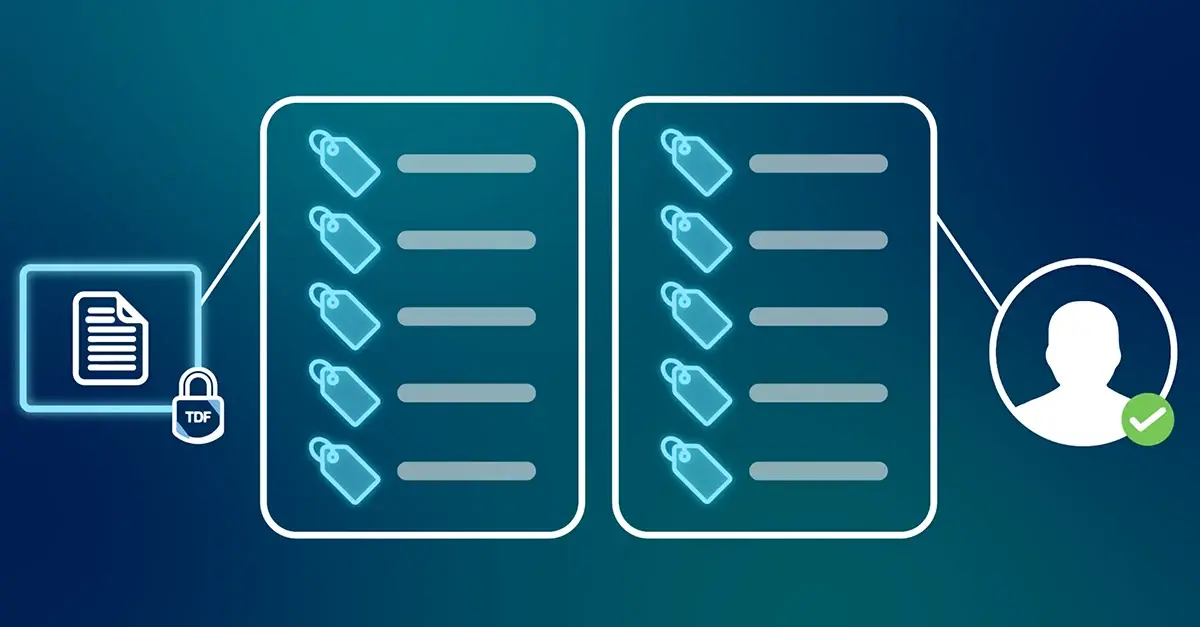
A lot of our approach has been built on the Zero Trust Data Format. Our ability to protect the information but also to embed those protection mechanisms actually with the data, so it can be protected when we release it beyond our own control. And we can still have assurance that it's being protected wherever it travels to and whoever receives it.

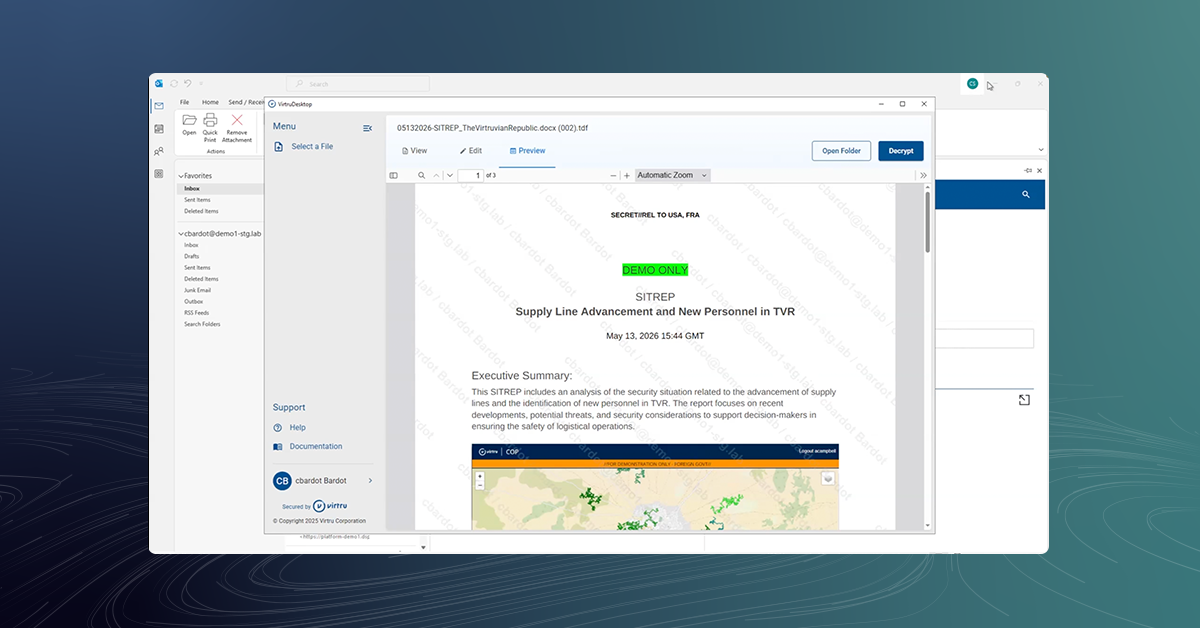
You look at the example of a Word file. We would label that information. So we would give it a classification, so maybe secret information.

We would give it releasability, so maybe it's Five Eyes or NATO releasable. We're then able to transform that information into a protected form, the Zero Trust Data Format.

SIR JIM HOCKENHULL:

Our approach of having network-based security just doesn't work, because once someone's through that wall, and there'll always be a way of getting under, around, or through those walls, the risk is that they can then do all sorts of damage. If we can make this a much more granular approach to how we do our security, then even if a bad thing happens, it's a small bad thing that you can correct quite quickly. But what it does do on the upside, it gives you amazing opportunity to exploit your data very differently.

It kind of works in the background, but the upside in terms of how you exploit your data is exponentially more than the challenge of adoption. And in a strange way, it may actually also help with the idea of how we deter our adversaries. Because if we can demonstrate to adversaries that we've got such control of our information that we can exploit that data at machine speed, then that may mean that our adversaries are deterred from taking action against us, because they recognize that this will lead ultimately to their defeat.

ANDREW GARNER:

When we're talking about warfighting, data-centric security has the potential to not only protect our information but also have impacts way beyond what we might initially have considered, and saving lives, ultimately, is one of those outcomes. We are on the cusp of a significant evolution of our architectures, of our information processing and sharing capabilities, to enable a much more efficient and effective means by which we can conduct our operations and collaborate with our allies and partners.

SIR JIM HOCKENHULL:

I think there is the opportunity to see wide-scale adoption. We've seen the agreement amongst the Five Eyes partners of ACP-240, and what that's doing is setting a standard for how we're going to operate and work together. I think the next stage of that is to see NATO setting a similar standard.

So we move from five out to all of NATO being able to operate using the same technology. As I look at the various ways in which this problem could be solved, the reason I'm attracted to joining Virtru is this is the solution at the right time and the right moment for our collective national security. And of course, the better we can make all of those nations in how they share and exploit their data and how they interoperate with others, it makes us all collectively safer.

I'm sure that it'll be good for Virtru, but I'm certain it's going to be good for our collective defense.