







Video
Extensibility: Governing Data in a Live Map
One live map, many data owners, and every operator entitled to see something different. See how Data Harbor enforces policy inside an app already in production.
Read transcript Hide transcript
I'm Cassandra, an engineer here at Virtru.
If you're the person who gets handed the job of introducing granular access control to protect sensitive data in an app that's already in production, this part's for you.
The scenario I'm about to show you is hypothetical. The app isn't. It's a fully working common operating picture. One live map pulling in data from many different sources, and access to every piece of it has to be governed two ways, by the data owners who labeled it and by what each signed in person is entitled to see.
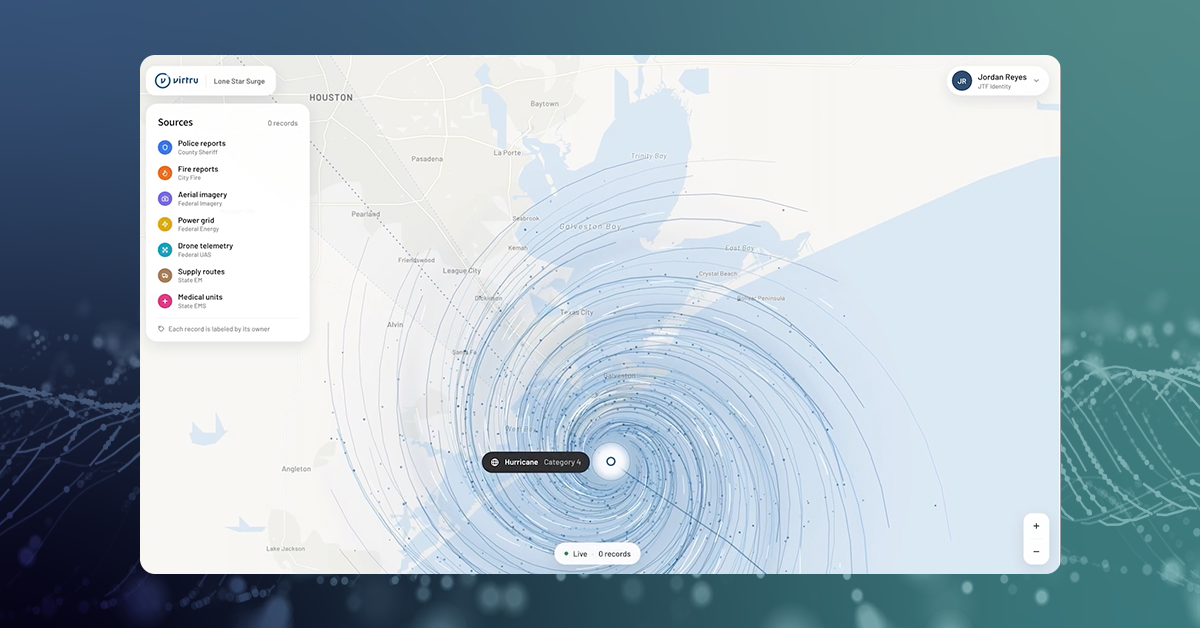
So here's the scenario. A hurricane has come ashore near Galveston, Texas and a joint task force is coordinating the response.
Reports from local law enforcement, reports from fire crews, and resources from national agencies, aerial imagery, power grid data, drone streaming, live telemetry, and more.
Different kinds of data from different owners all on one map.
And it's the policy that decides which information each operator gets to see.
Let's see how this works in the app.
Everything starts with the data owners.
They know best how sensitive their data is, so each owner labels that data before anything reaches the map. Clearance, compartments, and who's allowed to receive it.
Once wrapped in TDF, every report, image, or drone update becomes a protected data payload with its attributes traveling alongside.
That labeling matters because every downstream decision depends on those labels.
Take this ambulance strike team.
The owner labeled this record responder, medical and logistics, releasable to the task force, and named partners.
Those are the attributes on the data.
The other half of governance is entitlements on identities, human and nonhuman alike.
Each responding party signs in through its own identity provider, and the attributes it supplies determines what each identity is entitled to see.
A governing policy connects the two. Higher clearance covers lower.
You need every compartment on a record. One matching agency is enough to share. And if your agency's identity provider says you're a medic, the policy entitles you to the medical compartment.
So how did our team extend the Data Harbor platform's decisioning and enforcement into this app?
The platform is extensible by design, and we use the same developer tools available to you. SDKs in the languages your teams already use, like Go and JavaScript. APIs for managing the attributes and policy, and a command line tool to script all of it. Using the SDK, we put an enforcement point right inside the app.
It's the same pattern the partners you heard from earlier used in their own products. When the map wants to show you something, it asks the platform, which decides first. On a yes, the key comes back and the SDK decrypts the payload. On a no, it stays encrypted, and we didn't have to rewrite the app to get there.
Jordan Reyes commands the task force. His entitlements meet every requirement on the strike team record, so it appears on his map.
A liaison officer from an international partner signs in through her own agency's identity provider. Same map, same record. But she isn't cleared for medical, so there's no key and it stays encrypted.
Hiding the dot is just presentation. The decision was never the apps to make.
And the state's logistics dispatch system signs in as itself with its own entitlements. Grid data and drone feeds open for it. The strike team doesn't.
And when the international team's mission wraps up, the task force changes one policy.
The liaison officer's next request is denied even for records already on her laptop.
And every decision granted or denied is on the record with cryptographic evidence for every grant.
So attributes on the data set by its owners, entitlements on every identity from each party's own identity provider, and the Data Harbor platform deciding and enforcing inside an app that already existed.
That's what Extensible looks like.
If you're the person who gets handed the job of introducing granular access control to protect sensitive data in an app that's already in production, this part's for you.
The scenario I'm about to show you is hypothetical. The app isn't. It's a fully working common operating picture. One live map pulling in data from many different sources, and access to every piece of it has to be governed two ways, by the data owners who labeled it and by what each signed in person is entitled to see.
So here's the scenario. A hurricane has come ashore near Galveston, Texas and a joint task force is coordinating the response.
Reports from local law enforcement, reports from fire crews, and resources from national agencies, aerial imagery, power grid data, drone streaming, live telemetry, and more.
Different kinds of data from different owners all on one map.
And it's the policy that decides which information each operator gets to see.
Let's see how this works in the app.
Everything starts with the data owners.
They know best how sensitive their data is, so each owner labels that data before anything reaches the map. Clearance, compartments, and who's allowed to receive it.
Once wrapped in TDF, every report, image, or drone update becomes a protected data payload with its attributes traveling alongside.
That labeling matters because every downstream decision depends on those labels.
Take this ambulance strike team.
The owner labeled this record responder, medical and logistics, releasable to the task force, and named partners.
Those are the attributes on the data.
The other half of governance is entitlements on identities, human and nonhuman alike.
Each responding party signs in through its own identity provider, and the attributes it supplies determines what each identity is entitled to see.
A governing policy connects the two. Higher clearance covers lower.
You need every compartment on a record. One matching agency is enough to share. And if your agency's identity provider says you're a medic, the policy entitles you to the medical compartment.
So how did our team extend the Data Harbor platform's decisioning and enforcement into this app?
The platform is extensible by design, and we use the same developer tools available to you. SDKs in the languages your teams already use, like Go and JavaScript. APIs for managing the attributes and policy, and a command line tool to script all of it. Using the SDK, we put an enforcement point right inside the app.
It's the same pattern the partners you heard from earlier used in their own products. When the map wants to show you something, it asks the platform, which decides first. On a yes, the key comes back and the SDK decrypts the payload. On a no, it stays encrypted, and we didn't have to rewrite the app to get there.
Jordan Reyes commands the task force. His entitlements meet every requirement on the strike team record, so it appears on his map.
A liaison officer from an international partner signs in through her own agency's identity provider. Same map, same record. But she isn't cleared for medical, so there's no key and it stays encrypted.
Hiding the dot is just presentation. The decision was never the apps to make.
And the state's logistics dispatch system signs in as itself with its own entitlements. Grid data and drone feeds open for it. The strike team doesn't.
And when the international team's mission wraps up, the task force changes one policy.
The liaison officer's next request is denied even for records already on her laptop.
And every decision granted or denied is on the record with cryptographic evidence for every grant.
So attributes on the data set by its owners, entitlements on every identity from each party's own identity provider, and the Data Harbor platform deciding and enforcing inside an app that already existed.
That's what Extensible looks like.
Related Resources
Get expert insights on how to address your data protection challenges
/2026%20Video%20Resources/FMV-final.webp)
November 18, 2026
Extensibility: Full Motion Video Management
/2026%20Video%20Resources/calder-bay-financial.webp)
November 18, 2026
Agentic Governance: Letting the Data, Not the Agent, Decide Who Sees What
/2026%20Video%20Resources/dots%20on%20a%20map.webp)
November 18, 2026
Extensibility: Governing Data in a Live Map

/video%20-%20booz%20allen%20billington/Virtru%20+%20Booz%20Allen.webp)
September 17, 2026
The Great Inversion: When Zero Trust Finally Reaches the Data | Booz Allen + Virtru
August 10, 2026
Virtru Platform Demo: ABAC for Outlook, SharePoint, and Beyond
July 28, 2026
Zero Trust File Sharing with Virtru Data Harbor

July 28, 2026
The Virtru Platform: Extensible Security and SDKs for Mission Apps
June 29, 2026
How It Works: Virtru Collaborate
June 15, 2026
Virtru Collaborate: Eliminate the Tradeoff Between Compliance and Collaboration

May 19, 2026
Introducing Virtru Collaborate
May 1, 2026
Virtru Collaborate: Securely Store, Organize, and Share Sensitive Files
March 1, 2026
Google E2EE vs. Virtru for Gmail: Sender and Recipient Experience
Book a Demo
Become a Partner
Contact us to learn more about our partnership opportunities.
Become a Compliance Champion
Contact us to learn more about our partnership opportunities.