If you're in the financial services industry, you have significant data security requirements to meet — from GLBA compliance to FTC Safeguard Rule and beyond.
With Virtru, you can make sure your clients' financial data remains protected, everywhere it moves — while making it easily accessible to your clients when they need it most.
PCI Compliant Data Protection for Banks and Financial Firms
Virtru provides commercial and investment banks, mortgage lenders, insurance companies, and other financial institutions, with data-centric security to maintain the privacy of confidential corporate and client data, wherever it is shared.
Virtru provides commercial and investment banks, mortgage lenders, insurance companies, and other financial institutions, with data-centric security to maintain the privacy of confidential corporate and client data, wherever it is shared.
Safeguard data flowing through your organization's digital workflows for gathering documents and communicating with clients and partners — whether it's a mortgage application, a tax return, an auto loan, or a updated will.
Leverage Virtru's PCI compliant, easy-to-use encryption to maintain compliance with PCI,GLBA, SOX, FFIEC, GDPR,CCPA, and other regulatory requirements.
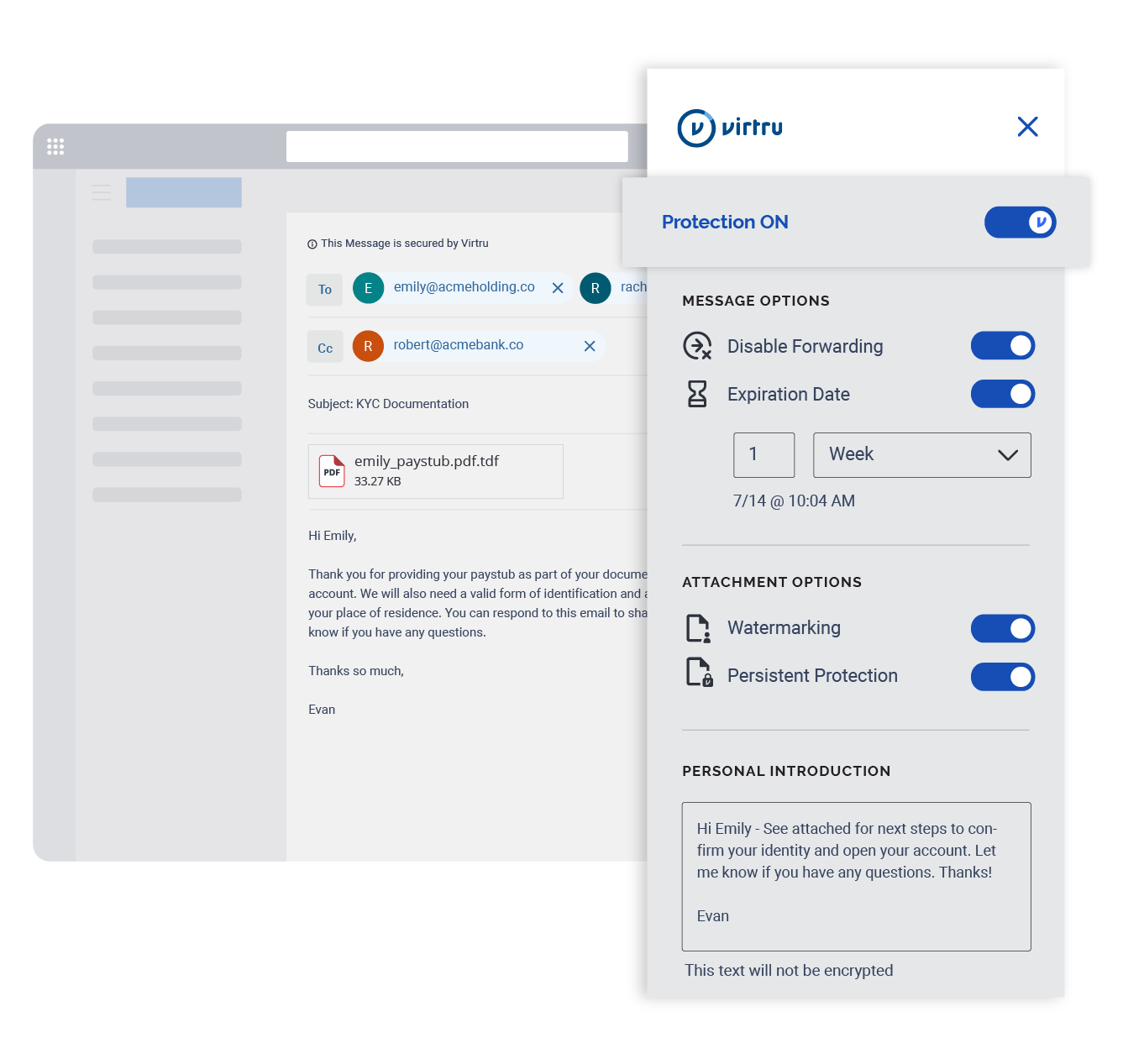
Deploy the Virtru Data Protection Gateway across your domain for an invisible but powerful layer of data protection. Administrators can configure DLP rulesthat scan emails and attachments to detect confidential data or PII, then automatically enforce protection that persists throughout collaboration workflows to keep communications private and controlled.
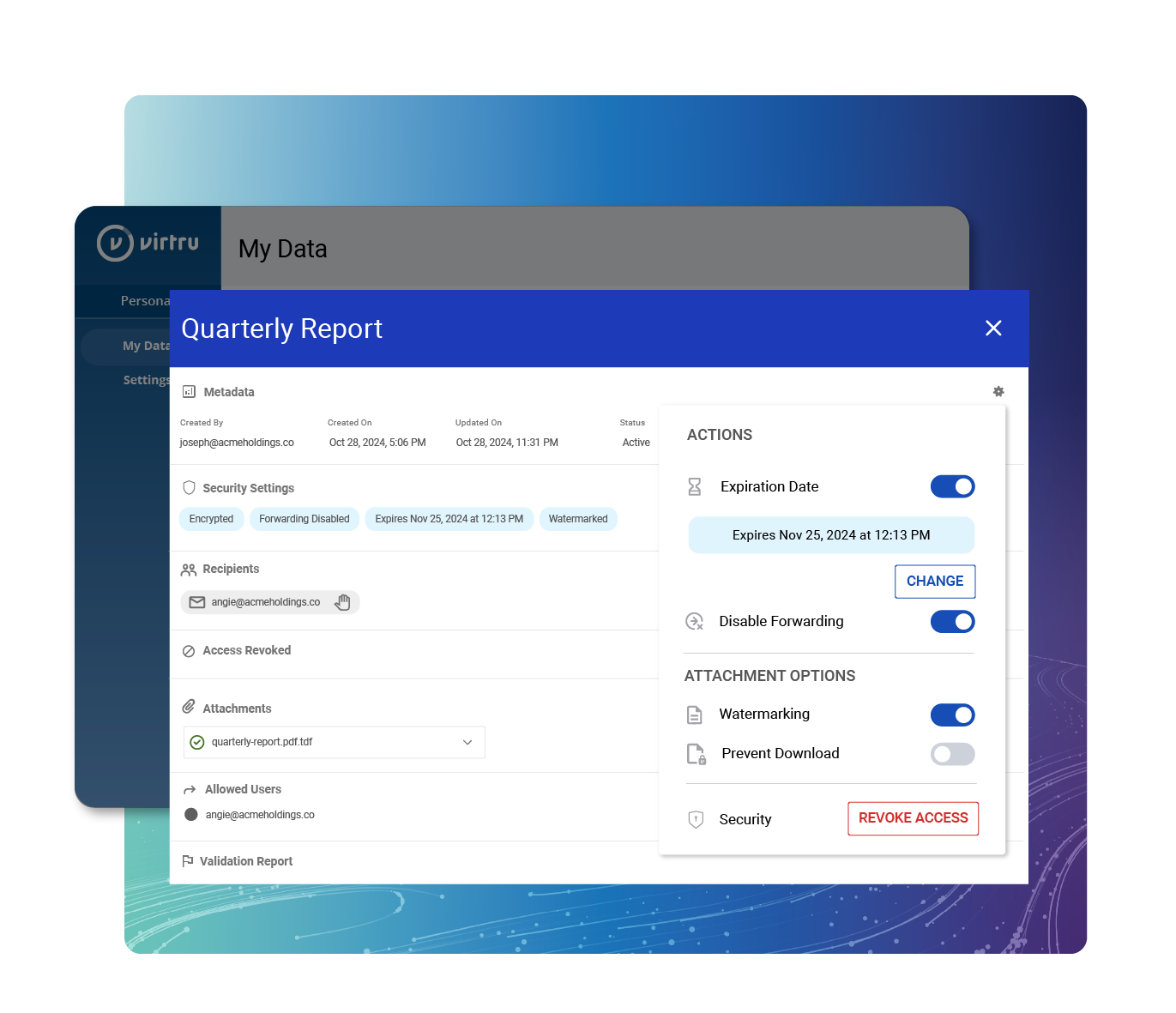
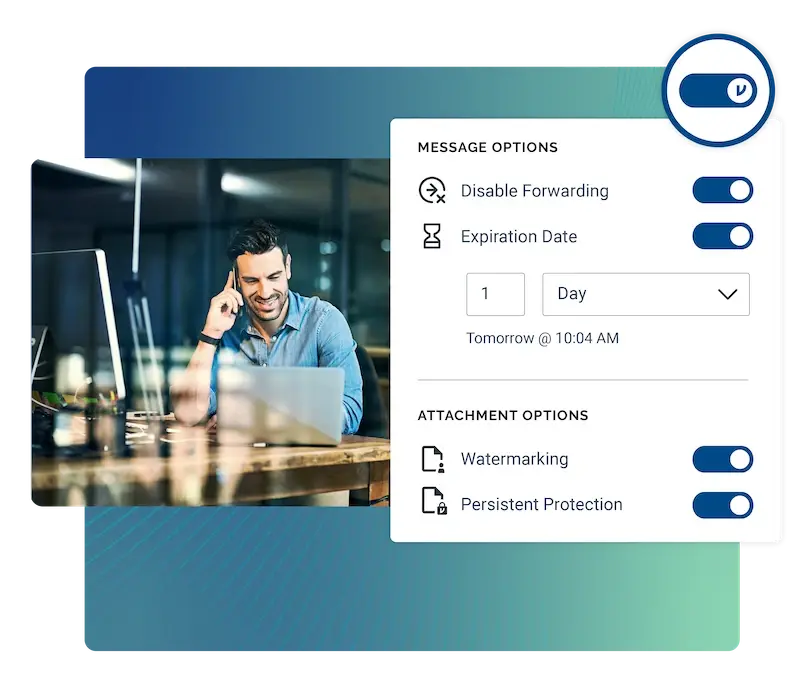
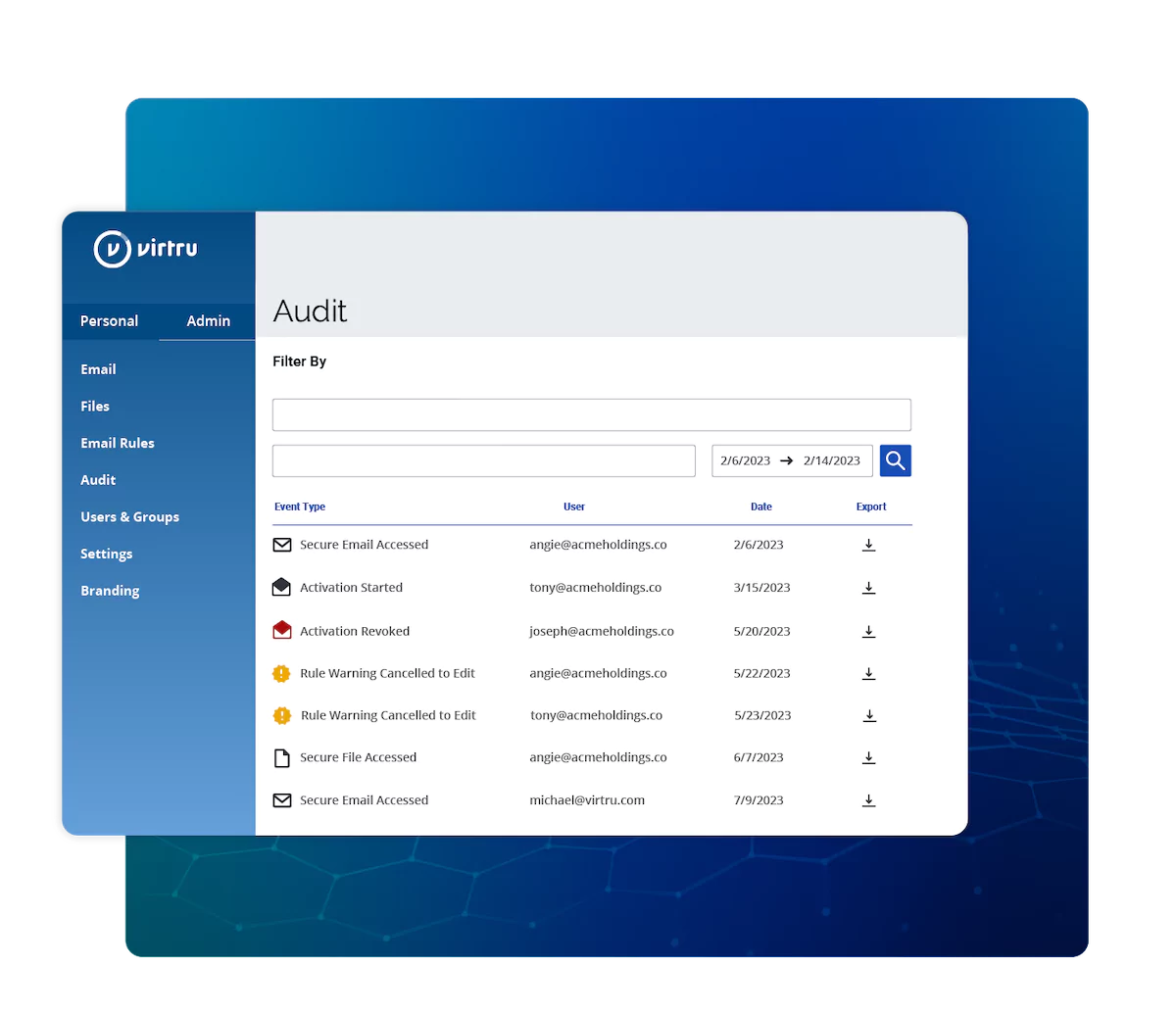
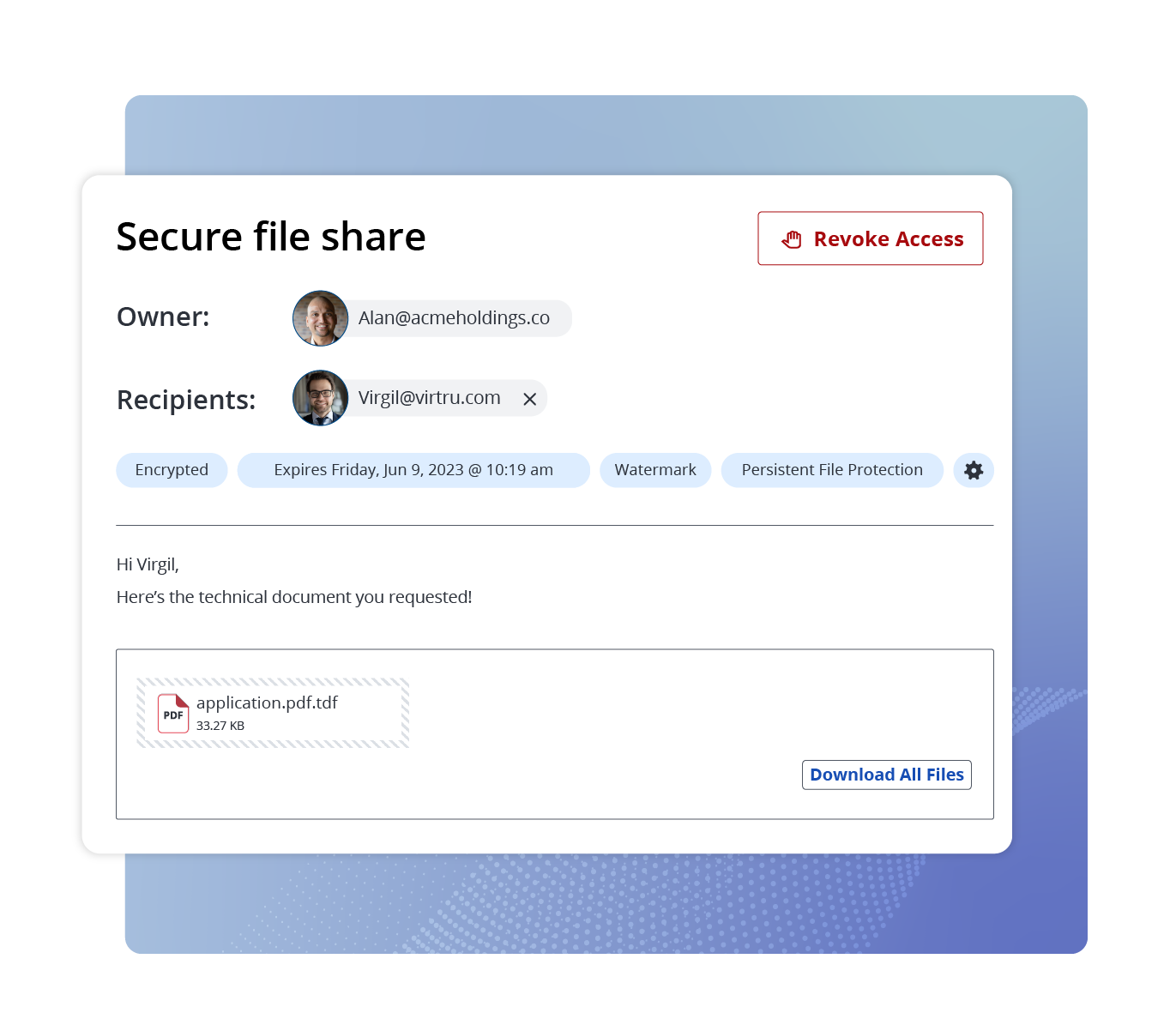
Unlike other portal-based encryption providers, Virtru not only encrypts sensitive data, but also provides persistent and granular control over that data. Revoke access any time, set expiration dates, add watermarks, and audit exactly how and when data has been accessed.
Certified. Validated. Trusted.
How SpotOn Protects Payment Data
PCI Compliant Email and File Sharing
When time is money and client relationships are paramount, Virtru enables banks and fintech companies to safely exchange information with external parties, supporting GLBA and FINRA compliance.
Virtru Success Story: How One of the World's Largest Banks Deployed Virtru
In this podcast episode, Virtru's Matt Howard and Dana Morris discuss how one of the world's largest banks uses Virtru as a layer of seamless security to protect data shared with its high-value clients.
Encrypt and Control Emails Containing KYC and Financial Details
Encrypt Outlook and Gmail emails, client communications, sensitive documents, or any other file type containing PII or confidential, regulated data. Virtru is PCI-DSS compliant, and its persistent access controls give you control over sensitive information even after it's left your perimeter.
Virtru’s end-to-end encryption streamlines compliance with FTC, SEC, and other regulatory frameworks by keeping data truly private and preventing both intentional and unintentional data loss.
Control Your Own Encryption Keys for Data Sovereignty and Heightened Privacy
You can host your own encryption keys with the Virtru Private Keystore for even greater control over sensitive data to prevent unauthorized access, including by your cloud provider.
Why Banks, Credit Unions, and Tax Preparers Choose Virtru:
Easy to Use
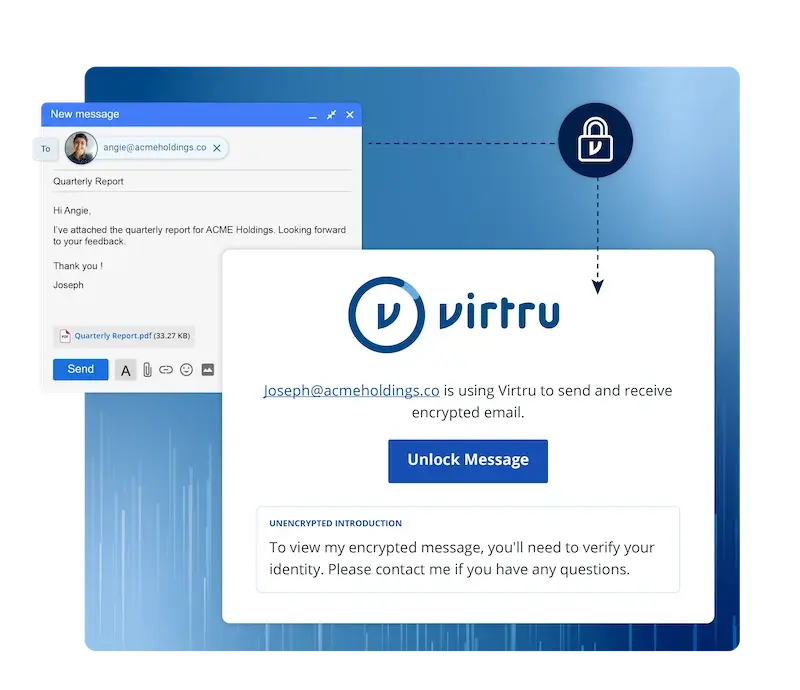
Far and away, Virtru is the industry leader in easy-to-use cybersecurity. Not only is it easy for your internal teams, but it's also easy for recipients to access protected data: They log in with existing credentials, so there are no new logins to create or remember.
Accelerates Speed of Communication
Whether you're requesting KYC documentation from a customer or processing a loan application, Virtru helps you securely send and receive the important information necessary to get the job done — while staying compliant with regulations.
Supports Financial Services Regulations
When it comes to financial services regulations like GLBA, FINRA, and FTC Safeguards, you don't want to find yourself in breach of compliance. Virtru supports your compliance efforts with military-grade security that your teams will actually use.
Avoid S/MIME and SFTP Headaches
Avoid the complexities of S/MIME and SFTP solutions with easy-to-use, transparent security tools that meet your teams where they work.
Ready to take the next step?
6,100 CUSTOMERS TRUST VIRTRU FOR DATA SECURITY AND PRIVACY PROTECTION.
STANDARD_PAGE...
Frequently Asked Questions about Virtru for Financial Services
Financial institutions face an expanding attack surface: employees sharing loan documents over unencrypted email, mortgage packets exchanged via consumer file-transfer tools, and customer PII moving through partner ecosystems without persistent protection. Data security in banking is complicated by the fact that sensitive data doesn't stay inside your perimeter — it travels to customers, partners, and regulators. Once a file leaves your environment, traditional perimeter security can't follow it. Data-centric security solves this by encrypting data at the object level and keeping controls attached to the file itself, no matter where it goes.
Financial services organizations operate under some of the strictest data protection requirements in any sector — PCI DSS for cardholder data, GLBA and the FTC Safeguards Rule for consumer financial information, SOX for corporate records, and FFIEC guidance for exam readiness. Beyond compliance, financial firms are high-value targets: a breach affecting customer account data, M&A documents, or KYC records carries outsized reputational and financial consequences. That combination of regulatory complexity and threat exposure makes financial services secure data practices a board-level priority, not just an IT concern.
Data-centric security means protection is built into the data itself — not just the systems that hold it. Instead of relying on network perimeters, access controls evaporate the moment a file is forwarded or downloaded. With a data-centric approach, every file and email is encrypted and carries its own policy: who can open it, for how long, and under what conditions. If a loan officer sends a mortgage application to the wrong recipient, access can be revoked after the fact. That persistent control is what makes data security in banking practical across complex, multi-party workflows.
The PCI Data Security Standard (PCI DSS) is a set of technical and operational requirements established by the Payment Card Industry Security Standards Council to protect cardholder data. It applies to any organization that stores, processes, or transmits payment card information — including banks, credit unions, fintech companies, insurers that accept card payments, and any service provider in the cardholder data environment. Non-compliance can result in fines, increased transaction fees, and loss of card processing privileges.
PCI compliance requires that cardholder data be encrypted both in transit and at rest, with strict access controls and audit logging. Virtru's platform enforces encryption at the data layer — meaning files and emails containing card data are protected end-to-end, not just while sitting on a server. Admins can set granular access policies, revoke access retroactively, and pull detailed audit logs showing exactly who accessed what and when. Virtru is also PCI DSS compliant itself, so it fits cleanly into a compliant cardholder data environment without introducing new risk.
Yes. Virtru's platform is purpose-built for the regulatory complexity of financial services, with capabilities that map to GLBA, FTC Safeguards Rule, SOX, FFIEC, GDPR, and CCPA requirements — in addition to PCI. The platform's key management controls, including Virtru Private Keystore for organizations that need to host their own encryption keys, are especially relevant for firms operating under data residency or sovereignty requirements. Virtru holds SOC 2, FIPS, and FedRAMP authorizations, which simplify third-party risk reviews and auditor inquiries.
Banks and mortgage lenders use Virtru to protect the high-volume, multi-party document flows at the core of their business: loan applications, income verification documents, title searches, KYC packets, and M&A due diligence files. Virtru's Secure Share feature creates encrypted digital workflows that replace consumer-grade tools like email attachments and public file-sharing links. Recipients access documents using credentials they already have — no new account required — which keeps deal velocity high while maintaining the persistent protections required for financial services secure data practices.
Standard email sends sensitive data in plaintext or with transport-level encryption that drops the moment the message is delivered. SFTP is more secure but requires technical setup on both ends, creating friction that leads employees to route around it. Neither approach gives you persistent control after delivery: you can't revoke access, set expiration dates, or audit who forwarded a file to whom. For data security in banking — where a single misdirected email containing a customer's financial records can trigger a breach notification — neither option is adequate.
Insurance companies handle some of the most sensitive personal data in any industry: health histories, income records, claim documentation, and legal correspondence. Data protection for insurance companies is complicated by the fact that this data flows constantly between policyholders, agents, underwriters, third-party administrators, and regulators — often over email. Traditional security tools protect the inbox but not the attachment once it's been downloaded or forwarded. Virtru's persistent encryption keeps protection on insurance documents throughout their full lifecycle, giving compliance teams the control and audit visibility they need.
Yes. Virtru integrates natively with Microsoft Outlook, Microsoft 365, Gmail, Google Workspace, OneDrive, SharePoint, and Microsoft Teams — the tools most financial services teams already rely on. There's no separate portal or workflow change required. Users protect and share sensitive files from inside the applications they already use, which is critical for adoption in high-volume, time-sensitive financial workflows. Protection runs automatically in the background via Data Protection Gateway policies configured by administrators, so compliance doesn't depend on individual employees making the right choice.
Bring Your Own Key (BYOK) means your organization controls the encryption keys that protect your data — not your software vendor. This matters for financial services firms operating under strict data sovereignty requirements, institutions subject to regulatory examination, or any organization that needs to ensure a vendor cannot access its customers' sensitive data under any circumstances. Virtru Private Keystore lets you host your own keys in your own infrastructure, so you retain full control. Even Virtru cannot decrypt your data. It's the architecture regulators and auditors increasingly expect from firms handling cardholder data, consumer financial records, and proprietary deal information.
If a document is sent to the wrong party, shared with someone whose access should be terminated, or involved in an employee departure, Virtru lets administrators revoke access immediately — even after the file has been downloaded. The encryption is persistent: the file remains unreadable without a valid decryption token, and once revocation is applied, that token is invalidated. This capability is particularly valuable in financial services, where the lifecycle of sensitive documents spans months or years and team composition changes frequently.
Book a Demo
Become a Partner
Contact us to learn more about our partnership opportunities.
Become a Compliance Champion
Contact us to learn more about our partnership opportunities.