
Share post:


TABLE OF CONTENTS
See Virtru In Action
Share post:
Organizations evaluating Box alternatives for file sharing often start with the same question: What does Box do well, and where does it fall short?
Box is excellent at what it does. If you need a cloud content platform with strong governance, solid compliance certifications, and a mature collaboration suite, Box earns its reputation. But, an important question to consider is: What happens to a file after it leaves Box?
A user downloads a sensitive contract and emails it to outside counsel. A subcontractor saves a project file to their local desktop. A partner forwards a protected document to someone outside the original access list. In each of these scenarios — which happen dozens of times a day in any enterprise — Box's security controls are no longer in effect.
This is exactly what makes Virtru Collaborate unique in the file sharing space.
It's a tension that our customers articulate clearly. "I had to use Box before Virtru, mainly because a specific customer was used to it," said one IT Manager at an AI-powered cybersecurity solutions provider, "but I really prefer keeping things with one vendor. Since Virtru Collaborate can handle larger files and support our use cases, that's a better solution than having to use something like Box or DocSend."
When it comes to collaborating on highly sensitive data, the question is whether Box can actually do the job — across the full lifecycle of the data. But what happens when a sensitive file leaves the platform?
The Big Difference Between Platform-Bound vs. Data-Centric Security
Box's security model is powerful, but it's fundamentally platform-bound. Box Shield's Smart Access policies enforce access restrictions while a file lives inside Box. Box KeySafe (BYOK) authorizes decryption per access event — but the decrypted file is what leaves Box when a user downloads it. A watermark exists on downloaded files, but the access controls do not travel with the file.
This is simply a feature of how traditional cloud content platforms work. They protect the perimeter of the platform. Once data crosses that perimeter, a different kind of protection is needed.
Virtru Collaborate takes a data-centric approach. Protection is embedded directly in the file itself using TDF (Trusted Data Format), an open standard originally developed from NSA technology and now stewarded by the OpenTDF community.
Here is a quick view of how Virtru Collaborate works.
Governed Workspaces vs. Shared Folders
Box's collaboration model is built around folders and access permissions. You share a folder, set permissions, and trusted collaborators work inside the Box environment. For internal or semi-internal collaboration where all parties have Box accounts, this model works well.
Virtru Collaborate is built for a different scenario: Sensitive external sharing where you cannot assume the other party is inside your ecosystem — and where compliance frameworks require you to prove control even after files are shared.
Virtru Collaborate's governed Workspaces provide isolated, purpose-built environments for sharing sensitive files with specific external parties. Each Workspace has its own member list, security settings, and audit trail. You can add outside counsel, a defense subcontractor, or a healthcare vendor by email — no separate account credentials required, and no need to grant access to your broader internal environment.
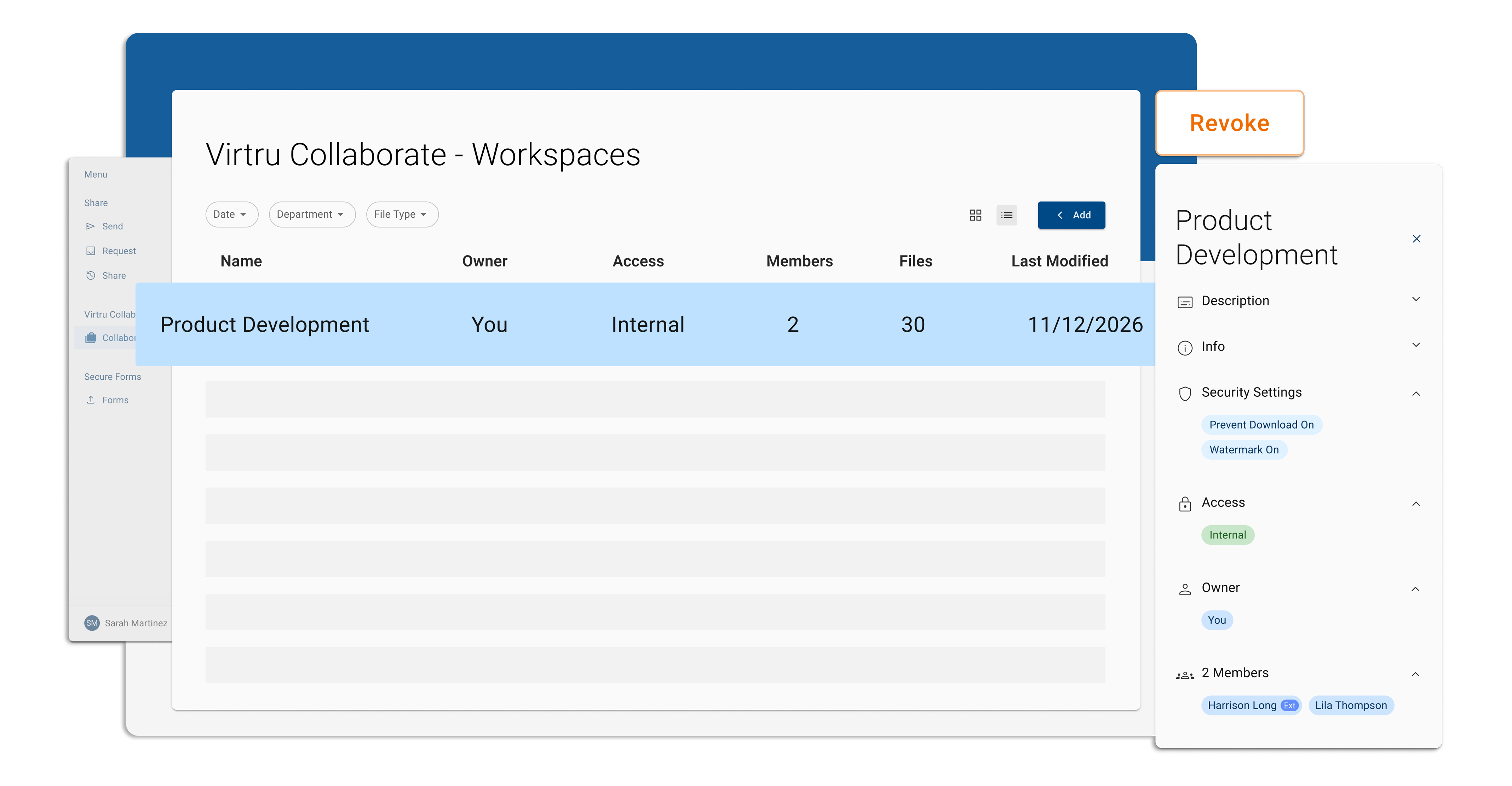
When the engagement ends, you can revoke access to all shared files, in seconds, with one administrative action.
For organizations withCMMC or NIST 800-171 obligations, HIPAA requirements, or GLBA/SOX compliance needs, Virtru Collaborate's FedRAMP authorized infrastructure and comprehensive audit trails provide the compliance documentation those frameworks demand.
Key Management Considerations: Box KeySafe
Box KeySafe is a genuine BYOK (bring your own key) offering. For Enterprise Plus customers, it provides customer-controlled keys in AWS KMS or Google Cloud KMS, with per-operation authorization that means Box never stores your master key. While that provides key custody options, there are some details to consider.
KeySafe coverage is partial.
File content is protected, but your full-text search index, file metadata, and comments remain on Box-managed keys, even with KeySafe active. For regulated buyers who need to demonstrate complete key sovereignty over all their data, the documentation tells a different story than the marketing does.
KeySafe is restricted to the Enterprise Plus tier.
Organizations on standard Enterprise or below cannot access BYOK — a structural ceiling for the mid-market segment that often needs key sovereignty most. One customer at a midsize defense and space technology company put it plainly: "To use ITAR on Box, they wanted $20,000 to set it up, plus we had to upgrade all user licenses to their highest enterprise plan — even though I only needed it for five users. That's why Virtru was a better option, since you support ITAR and can scale for our small team without requiring an expensive enterprise-wide upgrade."
The licensing architecture on Box compounds this. As one customer at an AI-driven digital identity verification company noted, "We're using Box for secure file sharing, but there are limitations because of licensing costs, so it's not available for everyone." When security features are gated behind tier upgrades, the users who most need protection — external-facing teams, regulated workflows, smaller departments — are often the ones who can't access it.
KeySafe authorizes decryption to enable access.
Once a file is decrypted and downloaded, the keys have served their purpose. The file on a user's machine is not KeySafe-protected; it's plaintext.
Virtru Collaborate's encryption key management model is different. Encryption stays cryptographically bound to the file through Virtru Private Keystore or managed key access service. The file that leaves Collaborate is still protected. File access still requires authorization upon open — and file access can be revoked at any time, regardless of where the file has traveled.
Recommended Reading: Data-Centric Security Technologies: The Key Management & Operations Layer
What Each Tool Is Actually Built For
Box is a content management and collaboration platform with security add-ons. Its core strength is giving your organization a governed home for files — versioning, co-editing, workflow automation, governance, and eDiscovery. If you need a complete enterprise content platform, Box provides it.
Virtru Collaborate was designed with data-centric security at the center: It is a secure external file sharing and collaboration product built specifically for the scenario where sensitive data needs to leave your environment — to a partner, a contractor, an auditor, a regulated third party — while you retain control and compliance documentation.
If your enterprise needs to fulfill both needs, you might consider running Collaborate alongside Box — using Box for internal content management, and Virtru Collaborate for the sensitive external sharing that Box's controls can't follow. Virtru can add a complementary layer for high-sensitivity workflows that you need to protect, audit, and continuously govern.
Users who've worked with both solutions have noted the difference in scope. "Box tries to do too much by providing lots of alternative tools," observed one CIO at an education institution. "I'm glad Virtru... doesn't get complicated or make users figure out new tools." That focused approach makes Virtru Collaborate a solution that users adopt and get their value out of.
A tool that requires training, account creation, and workflow changes will inevitably be bypassed. One that fits how people already work gets used. The question for your organization is simple: Do you have compliance obligations or security requirements that apply to files after they leave your platform perimeter? If yes, Virtru Collaborate addresses what Box cannot.
Compliance: A Genuine Differentiator for Box, and Where It Ends
Box is FedRAMP High authorized. For file storage and collaboration within the Box platform in a GovCloud deployment, that authorization holds.
However, the question FedRAMP High doesn't answer is what happens when data moves out of Box. FedRAMP authorization covers the platform — but it doesn't guarantee that files exported from that platform carry enforcement.
For CMMC Level 2, HIPAA, SOX, and GLBA requirements specifically, Virtru Collaborate's dynamic, secure Workspaces provide the audit-ready evidence those frameworks require, including:
-
Complete activity logs
-
Access controls
-
Persistent encryption that supports assessors' expectations — not just platform-level certifications.
Some requirements go beyond certification entirely. One customer at a cybersecurity and threat intelligence firm made the point directly: "Box was never going to work for us, but Virtru allows secure sharing from malware laptops directly into a secure environment, which is a capability Box can't match." When your threat environment includes potentially compromised endpoints, platform-bound security likely won't provide the level of granularity and confidence you're looking for.
A Practical Way to Think About It
Ask your security team a single question about your current file sharing setup: "When someone downloads a sensitive file from our shared environment and emails it to an external party, what controls are still enforced?"
If the honest answer is "none," that's the gap Virtru Collaborate was designed to address. And for organizations already paying for Box, the cost conversation eventually lands somewhere familiar. "Box is our most expensive product, so we're planning to move away from it next year," said one customer at a government technology solutions provider. "We've used Virtru for years with our email security — it's been an affordable, great product with no problems, unlike Box." Persistent encryption that travels with the file doesn't have to come with an enterprise-wide license requirement.
Security should empower, not stifle — and that means protecting data with the same rigor, whether it's inside your platform or traveling across organizational boundaries. Virtru provides first-mile to last-mile data protection, built on an open standard, without requiring external partners to adopt new tools or create accounts.
Box protects the platform. Virtru Collaborate protects the data itself, everywhere.
See the Difference for Yourself
Ready to see what persistent, compliant secure file sharing looks like in practice? Request a demo of Virtru Collaborate and see how governed Workspaces and persistent encryption work together — or speak with a solutions engineer about how Collaborate could fit alongside your existing Box investment.
Editorial Team
The editorial team consists of Virtru brand experts, content editors, and vetted field authorities. We ensure quality, accuracy, and integrity through robust editorial oversight, review, and optimization of content from trusted sources, including use of generative AI tools.
View more posts by Editorial TeamSign Up for the Virtru Newsletter
/blog%20-%20FIPS140-3/Virtru-FIPS1403.webp)
FIPS 140-3 Is the New Standard for Cryptographic Validation. Here Is What That Means for Your Data.
/blog%20-%20rocket.chat/Virtru-rocketchat-blog.webp)
Security Proven, Not Promised: How RocketChat and Virtru Enable Continuous Access Control
/blog%20-%20security%20triad/triad-blog.webp)
The Modern AI Security Triad
/blog%20-%20zero%20trust%20security,%20journey%20ends%20at%20the%20data/Zero-Trust-Peppo.png)
Zero Trust Security: The Journey Ends at the Data
/blog%20-%20Cymphony/cymphony-ai-workforce.webp)
Cymphony, AI Agents, and the Case for Security That Travels With Data

Nikesh Arora Is Right: It’s Time to Rethink Your Cyber Security Architecture

IBM’s Breach Report Makes the Case for Object-Level Data Security

Should You Go Against the Flow? Virtru vs. FlowCrypt PGP Encryption

The DoD SAFE Alternative Your Team Will Actually Use

Are Google Workspace and Microsoft 365 HIPAA Compliant? What to Know in 2026
/BLOG%20-%20BLACK%20HAT%202026/black-hat-2026-learnings.webp)