
Share post:


TABLE OF CONTENTS
See Virtru In Action
Share post:
/blog%20-%20sendsafely%20takedown/26-Competitor-Blog-Blog%20-%20Virtru%20vs%20SendSafely%20(1).jpg)
The short answer: SendSafely encrypts the transfer. Virtru protects the file, everywhere it goes, forever.
If you're evaluating secure file sharing or encrypted file sharing tools, SendSafely will likely come up in your research. And if you've looked at both, you're probably already asking the right question:
What happens to a file after a recipient downloads it and saves it to their desktop?
That question exposes the core architectural difference between the two products and, for most regulated organizations, it's the only one that matters.
SendSafely's Encrypted File Sharing Limitations: What Happens After Download
Secure File Transfer Stops at the Link: No Protection After Download
SendSafely encrypts files in transit and while they live inside the portal. The moment a recipient saves a file locally, that protection does not travel with it. There is no revocation mechanism for downloaded files, no policy enforcement after delivery, and no way to restrict what a recipient does with a file once it has left the portal environment.
For any organization sharing sensitive documents externally, the highest-risk moment is not the transfer. It's everything that happens after.
Not Built for Enterprise File Sharing Security
When you look at where SendSafely has gained real traction, a pattern emerges: it's most at home in consumer-facing document collection scenarios, particularly in fintech and crypto.
It makes sense, but it's a fundamentally different problem than enterprise file sharing security, encrypted document sharing, or compliance-driven secure external file sharing across healthcare, defense, or financial services.
Organizations evaluating SendSafely for those contexts may find themselves working around the product more than with it.
No FedRAMP, No CMMC, No BYOK: The Compliance Ceiling
SendSafely offers SOC 2 Type II and a HIPAA business associate agreement at certain plan tiers. Beyond that, their public compliance posture doesn't extend to federal authorization frameworks, customer-controlled key management, or government-grade certifications.
For organizations with CMMC, FedRAMP, ITAR, or similar requirements, it's a hard stop.
Recommended Reading: Virtru Collaborate vs PreVeil Drive: Choosing the Right File Enclave for CUI Workflows
Why HIPAA and FINRA Demand More Than Secure File Transfer
For organizations in healthcare and financial services, secure file sharing compliance requirements don't just ask whether data was encrypted when you sent it. They ask what happened to it after.
Recommended Reading: Take Control of Your Financial Data with Virtru’s Secure Collaborative Workspace
Under HIPAA, the Security Rule's encryption requirements apply to ePHI at rest, not just in transit. Once a recipient downloads a file containing patient data and saves it to their laptop, that file is ePHI at rest on a device outside your control. HIPAA compliant file sharing requires more than encrypting the delivery link. HIPAA's Breach Notification Rule offers a safe harbor for properly encrypted data, but that protection only applies if the encryption actually travels with the file. If protection ends at download, so does your safe harbor.
Recommended Reading: HIPAA-Compliant File Sharing for Healthcare: What Good Actually Looks Like
Under SEC and FINRA rules, firms need detailed audit trails, granular access controls, and the ability to demonstrate who accessed sensitive financial documents, when, and from where. A secure file transfer tool whose protection ends when the link expires cannot provide that demonstration to an examiner.
The pattern is the same across both frameworks: regulators want to know what controls exist over data after it has left your environment. A secure file sharing tool can pass a surface-level security review. It cannot answer that deeper question.
Virtru's Encrypted File Sharing Platform: Persistent Protection Across Every Workflow
Virtru Collaborate: Secure External File Sharing Built for Regulated Industries
Virtru Collaborate is purpose-built for organizations that need secure external file sharing without losing control of their data. It runs on FedRAMP-authorized infrastructure, provides governed Workspaces with member-level access control, and generates audit trails designed specifically for CMMC Level 2, HIPAA, and SOX assessors. Access can be revoked in real time, per file or per Workspace, whether a recipient opened the file five minutes ago or five months ago.
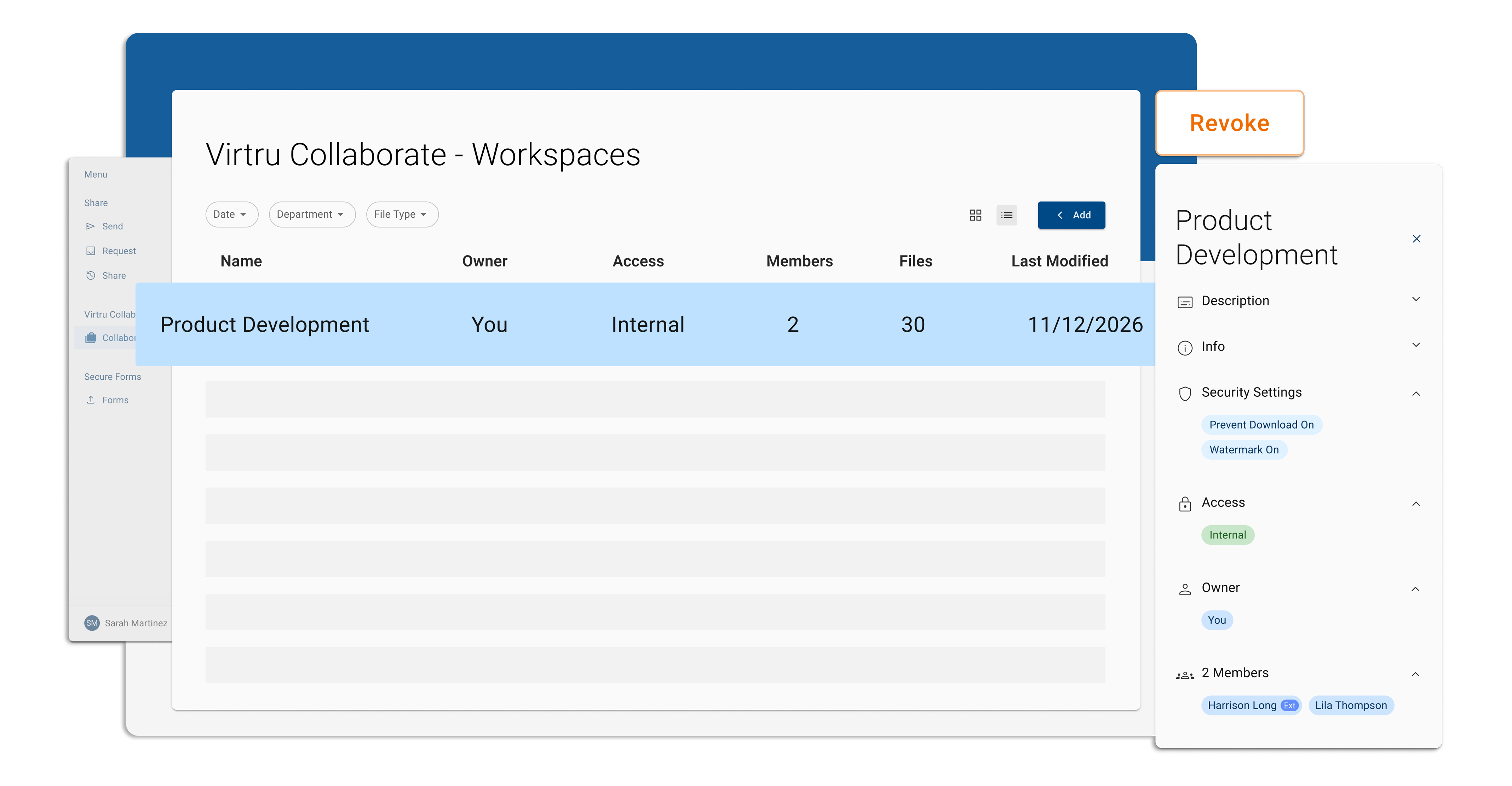
For defense contractors managing CUI, or any regulated organization sharing sensitive documents with external partners, this is a fundamentally different level of assurance than a secure link portal.
Virtru Secure Share: Encrypted File Sharing With Persistent Protection
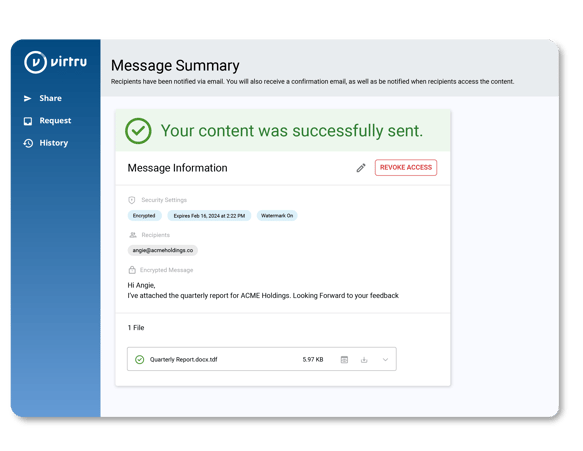
Virtru Secure Share brings that same post-download protection to everyday encrypted file sharing. Powered by the Trusted Data Format (TDF), encryption travels with the file itself, not the delivery link.
Recipients authenticate to access the file regardless of where it lives or how long ago it was shared. Admins can revoke access instantly, track when files are opened, and enforce download restrictions, all from a centralized dashboard.
iRCM, Inc., a healthcare revenue cycle management company, switched from SendSafely to Virtru after running into persistent friction with external collaborators and mobile users. Their Senior Compliance Manager described the impact:
"Having a solution which can incorporate in your day-to-day emailing, and day-to-day file sharing process flow is really helpful and, to be honest, one of the most efficient approaches in taking your communication toward a more HIPAA compliant and secure manner."
External partners experienced so little friction with Virtru that some proactively asked to adopt it themselves.
Recommended Reading: iRCM, Inc. Champions HIPAA Compliance & Efficiency with Virtru Email and File Encryption
Enterprise Data Security Across Email, Files, and Workflows
Virtru's data protection extends well beyond secure file sharing. Virtru for Gmail and Virtru for Microsoft Outlook bring persistent, policy-enforced encrypted communication directly into the email clients your team already uses, with no workflow disruption.
The Virtru Gateway automates email encryption across email infrastructure without requiring end users to change a thing.
Across every surface, the architecture is consistent: the protection follows the data, not the link.
Secure File Sharing vs. Data Protection: Why the Difference Matters for Regulated Organizations
If you're comparing SendSafely and Virtru as secure file sharing solutions, it's worth being clear about what you're actually choosing between. SendSafely is a secure file transfer tool. Once the file is delivered, its job is done.
Virtru is a data protection platform. The file stays protected, controlled, and revocable no matter where it goes.
For organizations in healthcare, financial services, defense, or any compliance-driven vertical, that distinction is not academic. It's the difference between a secure file sharing tool that passes an initial security review and one that holds up when an assessor asks what happens to sensitive data after it leaves your environment.
SendSafely's protection follows the link. Virtru empowers your data to protect itself.
Ready to see what persistent encrypted file sharing actually looks like? Book a demo and we'll walk you through exactly what happens to your files after they leave your control.
Editorial Team
The editorial team consists of Virtru brand experts, content editors, and vetted field authorities. We ensure quality, accuracy, and integrity through robust editorial oversight, review, and optimization of content from trusted sources, including use of generative AI tools.
View more posts by Editorial TeamSign Up for the Virtru Newsletter
/2026%20BLOG/26-Blog-Protecting%20Patient%20Trust.webp)
Protecting Patient Trust: How NHS Leaders Can Enforce Policy Automatically
/blog%20-%20FIPS140-3/Virtru-FIPS1403.webp)
FIPS 140-3 Is the New Standard for Cryptographic Validation. Here Is What That Means for Your Data.
/blog%20-%20rocket.chat/Virtru-rocketchat-blog.webp)
Security Proven, Not Promised: How RocketChat and Virtru Enable Continuous Access Control
/blog%20-%20security%20triad/triad-blog.webp)
The Modern AI Security Triad
/blog%20-%20zero%20trust%20security,%20journey%20ends%20at%20the%20data/Zero-Trust-Peppo.png)
Zero Trust Security: The Journey Ends at the Data
/blog%20-%20Cymphony/cymphony-ai-workforce.webp)
Cymphony, AI Agents, and the Case for Security That Travels With Data

Nikesh Arora Is Right: It’s Time to Rethink Your Cyber Security Architecture

IBM’s Breach Report Makes the Case for Object-Level Data Security

Should You Go Against the Flow? Virtru vs. FlowCrypt PGP Encryption

The DoD SAFE Alternative Your Team Will Actually Use