
Share post:


TABLE OF CONTENTS
See Virtru In Action
Share post:
/blog%20-%20shared%20services%20model/shared-services-model%20copy.webp)
Your finance team just got another request from the parent company's accounting group. They need last quarter's transaction data, customer PII, and payment records. Someone suggests uploading it all to Google Drive. Again.
This is the shared services handoff problem, and it's more common than most organizations want to admit. When a parent company or centralized entity handles accounting, payment processing, HR, or analytics for subsidiaries and portfolio companies, sensitive data has to move constantly. The question is how to share it without losing control.
The Shared Services Handoff Problem
Shared services models exist because they work. Centralizing functions like accounts payable, payroll, or data analytics across multiple entities saves money and improves consistency. But that efficiency creates a data security challenge: constant data flow across organizational boundaries, often involving the most sensitive information your business handles.
Parent companies need ongoing access to subsidiary data. Marketing teams collaborate with centralized agencies. Finance departments share operational metrics with corporate analytics teams. Most organizations default to Google Drive or email because they're already there. The problem surfaces later when you can't prove who accessed payment card data six months ago, can't revoke access when a project ends, and can't explain to your CISO why sensitive data is sitting in someone's personal Drive folder.
Compliance frameworks like PCI-DSS 4.0, SOC 2, and GDPR require proof that only authorized people accessed sensitive data, that access was revoked when someone changed roles, and that you know exactly where your data went. Google Drive doesn't give you that proof. The audit trail ends the moment the file leaves your control.
How Virtru Secures Shared Services Collaboration
Virtru sits on top of your existing Google Drive or Microsoft environment. You're not ripping out tools people already use. You're adding the layer of control and visibility that those platforms don't provide when data crosses organizational boundaries.
Collaborate: Secure Workspaces for Cross-Entity Projects
Shared services arrangements require ongoing collaboration, not only one-time file transfers. Your analytics team needs to work with parent company data scientists on performance dashboards. Your finance team needs consolidated reporting environments. Traditional file sharing wasn't built for that.
Virtru Collaborate creates project-based secure workspaces where teams from different entities can work together on sensitive data. When your parent company's accounting team needs access to subsidiary transaction data, they get a controlled environment with encryption at the file level, granular permissions, and complete audit logs.
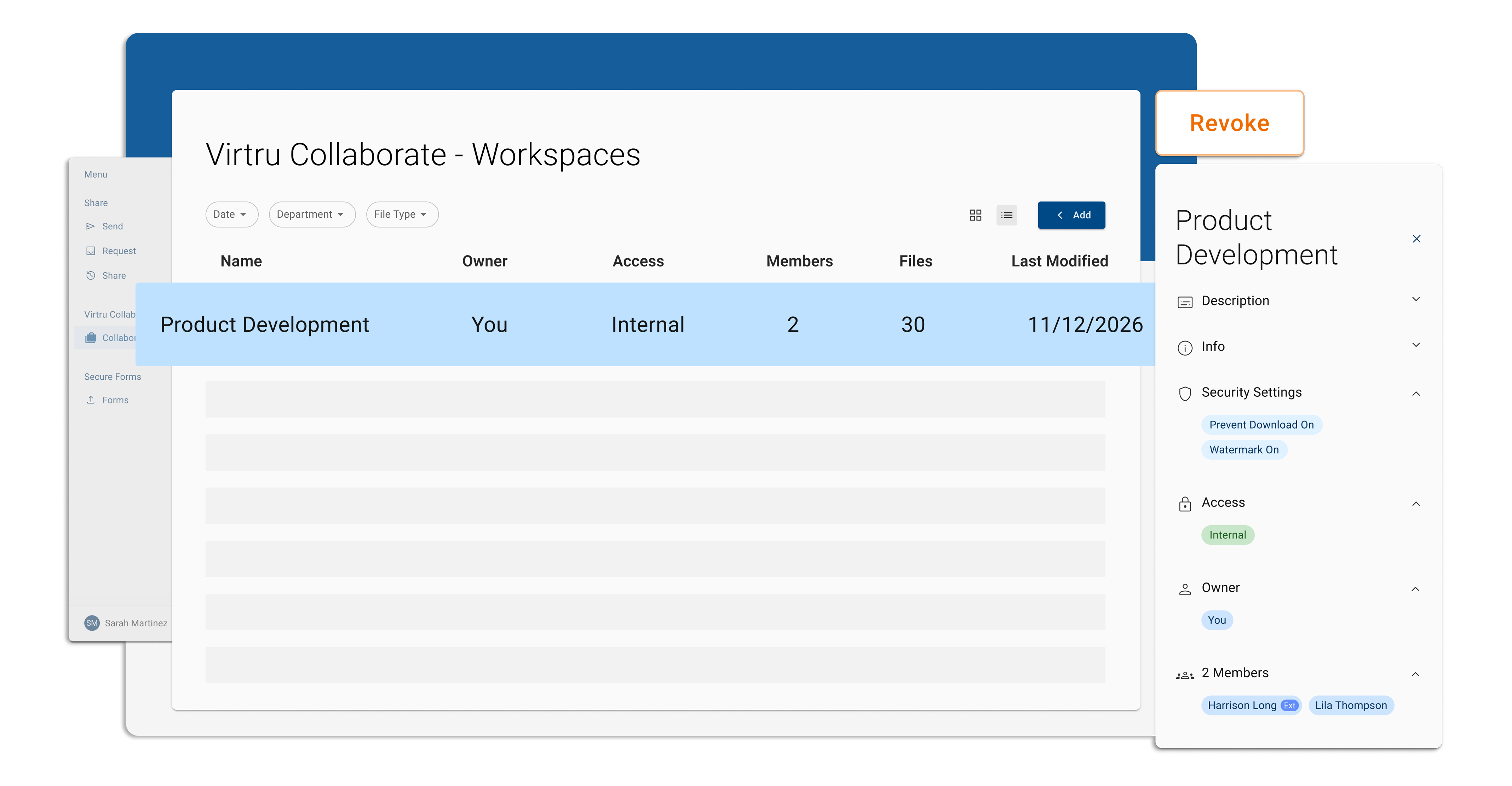
Here's what that looks like in practice:
-
Granular access controls: Set permissions per person, per file, per timeframe. When the Q4 close is done, accounting access to Q3 data expires automatically. No cleanup, no orphaned permissions, no "I forgot to revoke that share six months ago."
-
Audit trails that cross organizational boundaries: When your auditor asks who accessed payment card data last quarter, you get a real answer with timestamps, user IDs, and actions taken. Not Drive logs you have to manually piece together across multiple domains.
-
Revocation that actually works: When someone leaves the parent company or a project ends, access ends immediately. The encryption keys rotate, files become unreadable to former collaborators, and you have proof it happened.
-
Encryption that follows the data: Even if someone downloads a file from the workspace, it stays encrypted. They can only decrypt it while they have active permissions. Forward it to someone else? Still encrypted. Upload it to their personal Drive? Still encrypted and still under your control.
Secure Share: Controlled File Transfer When You Need Point-to-Point
Not every shared services workflow needs a workspace. Sometimes you just need to send a sensitive document to the parent company's legal team or transfer tax records to centralized accounting.
Virtru Secure Share handles controlled file transfer with the same visibility and control as Collaborate. Send a file, set an expiration, track who opened it, revoke access if plans change. The recipient doesn't need special software. They authenticate, access the file through their browser, and you maintain the audit trail.
Secure Share integrates directly into Google Drive, SharePoint, and OneDrive, so your teams don't change their workflow. Right-click a file, select "Share with Virtru," set permissions and expiration, and send. The file stays encrypted in transit and at rest. Your finance team doesn't have to learn a new tool to securely share Q4 results with the parent company's accounting team. They work exactly the way they already work, with encryption and access controls built into the share action.
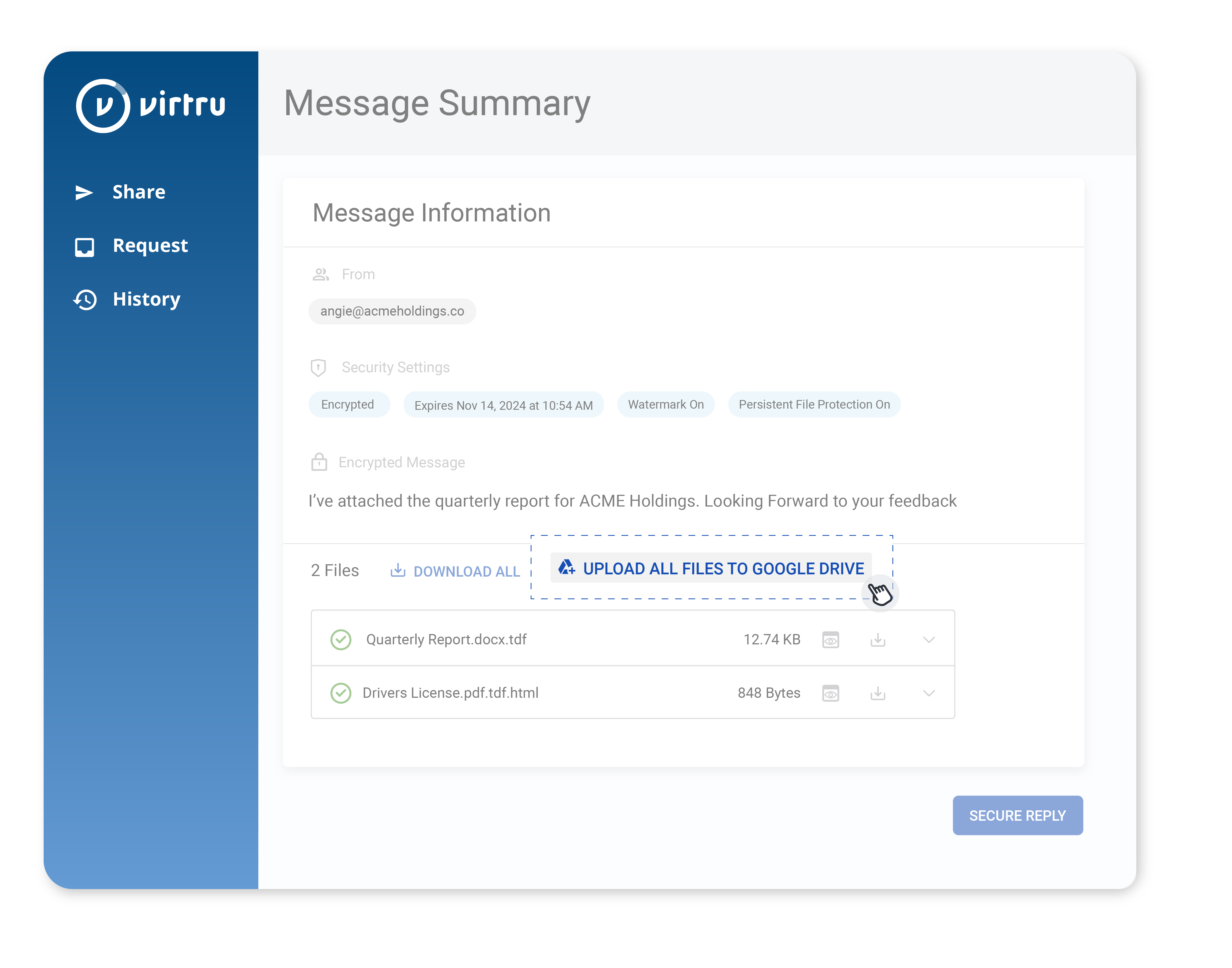
Both solutions work the same whether data is moving between your subsidiary and the parent company, between two portfolio companies, or from your finance team to an external auditor. The organizational boundaries don't matter. The controls follow the data.
What This Means for Compliance
PCI-DSS 4.0 requires organizations to restrict access to cardholder data by business need-to-know and maintain an audit trail of all access. When your parent company processes payments for multiple entities, that requirement applies across the entire shared services model. Virtru gives you the access controls and audit logs to prove compliance at every handoff.
SOC 2 requires documented access controls and the ability to revoke access when someone's role changes. When people move between entities in a shared services arrangement, those controls have to work across organizational boundaries. Virtru makes revocation immediate and auditable.
GDPR requires proof that personal data is only accessed by authorized parties and that access can be revoked on demand. When your HR data flows to a parent company for centralized payroll processing, Virtru provides the technical controls to demonstrate compliance across jurisdictions.
Where Shared Services Organizations Hit This First
Finance and accounting: Parent company runs consolidated AP/AR and payroll for multiple entities. Every pay period requires sharing employee data, tax information, and banking details. PCI-DSS 4.0 applies if any payment processing happens centrally.
Payment processing: Centralized PCI compliance with distributed point-of-sale operations. Card data flows from every location to a central processor. One breach anywhere in the chain puts the entire model at risk.
Data analytics: Shared dashboards for multi-entity performance reporting. Marketing metrics, operational data, and customer information all need to flow to a central analytics team while maintaining compliance with privacy regulations.
Marketing: Agency collaboration on brand campaigns across multiple entities. Creative assets, customer lists, and campaign performance data get shared with external partners who need access during active campaigns but shouldn't retain it indefinitely.
Each of these scenarios involves the same core challenge: continuous collaboration on sensitive data across organizational boundaries, with compliance obligations that require proof of control.
Most organizations don't realize they have a shared services data security problem until something forces the question. An audit finding. A compliance deadline. A close call with a data breach. By then, the Google Drive folders are already full of sensitive data, and nobody's sure who has access to what.
The time to secure your shared services model is before the auditor asks the question you can't answer.
Ready to secure your shared services data collaboration? Book a demo to see how Virtru Collaborate and Secure Share work in your environment.
Editorial Team
The editorial team consists of Virtru brand experts, content editors, and vetted field authorities. We ensure quality, accuracy, and integrity through robust editorial oversight, review, and optimization of content from trusted sources, including use of generative AI tools.
View more posts by Editorial TeamSign Up for the Virtru Newsletter
/2026%20BLOG/26-Blog-Protecting%20Patient%20Trust.webp)
Protecting Patient Trust: How NHS Leaders Can Enforce Policy Automatically
/blog%20-%20FIPS140-3/Virtru-FIPS1403.webp)
FIPS 140-3 Is the New Standard for Cryptographic Validation. Here Is What That Means for Your Data.
/blog%20-%20rocket.chat/Virtru-rocketchat-blog.webp)
Security Proven, Not Promised: How RocketChat and Virtru Enable Continuous Access Control
/blog%20-%20security%20triad/triad-blog.webp)
The Modern AI Security Triad
/blog%20-%20zero%20trust%20security,%20journey%20ends%20at%20the%20data/Zero-Trust-Peppo.png)
Zero Trust Security: The Journey Ends at the Data
/blog%20-%20Cymphony/cymphony-ai-workforce.webp)
Cymphony, AI Agents, and the Case for Security That Travels With Data

Nikesh Arora Is Right: It’s Time to Rethink Your Cyber Security Architecture

IBM’s Breach Report Makes the Case for Object-Level Data Security

Should You Go Against the Flow? Virtru vs. FlowCrypt PGP Encryption

The DoD SAFE Alternative Your Team Will Actually Use