
Share post:


TABLE OF CONTENTS
See Virtru In Action
Share post:

For decades, the standard for cybersecurity was the "castle and moat" strategy. You built high walls around your organization and assumed that everything inside was safe while everything outside was a potential threat. In that era, infrastructure giants like Check Point Security had the advantage because they could keep the "good guys" in and the "bad guys" out.
But today, business doesn't happen inside a castle. It happens in the cloud, in email threads, on mobile devices, and through collaboration with external partners. Furthermore, cybersecurity best practices "assume breach" — meaning you should act from the assumption that your network has already been accessed by an unauthorized bad actor. It's not just "good guys" accessing your network anymore.
While Check Point remains a solid Infrastructure Security provider — keeping bad actors out of your network — modern organizations are realizing that perimeter protection is no longer enough. Their acquisition of Avanan in 2021 aimed to expand their email security footprint, but the organization is still primarily focused on inbound threats, not enabling outbound secure collaboration.
To secure the vital information that flows through and out of your organization, you need data-centric security: Protection that travels with the data wherever it goes, allowing it to flow freely while remaining secure and well-governed.
Here is a detailed look at Virtru vs. Check Point, why relying solely on perimeter-focused tools leaves a critical gap in your security posture, and how Virtru fills it.
The Fundamental Difference: Threat Prevention (Defense) vs. Zero Trust Data Control (Offense)
To understand the difference between Check Point Harmony and Virtru, you have to look at what is being protected.
Check Point (specifically their Quantum and Harmony product lines) is focused on threat prevention. Their primary goal is to scan traffic at the gateway to stop malware, ransomware, and phishing attacks from infiltrating your environment. They want to be the guard at the gate, stopping threats from entering and compromising your domain. This is defensive cybersecurity — protecting the data you possess from loss or theft.
Virtru, conversely, focuses on Zero Trust data control. We don't just watch the door; we protect the VIP (your data) wherever it travels. We wrap each email and file in its own layer of encryption (using the open-standard Trusted Data Format). This protection travels with the data, ensuring it remains secure whether it is sitting on your server, moving through the Google or Microsoft cloud, or landing in a partner’s inbox.
A strong cybersecurity posture balances both defensive and offensive cybersecurity measures, mitigating inbound attacks and threats, without sacrificing the ability to share information securely with the right people and systems, at the right time.
The Limits of a Binary Gateway
Legacy email security tools often struggle with a simple reality of modern business: Data must sometimes leave the perimeter to be useful.
When you rely strictly on a perimeter gateway or firewall (like Check Point), you face a binary choice when sensitive data needs to leave the organization:
- Block it: The DLP (Data Loss Prevention) engine halts the workflow, frustrating users.
- Allow it: The file leaves the network, and you lose all control the moment it exits the gateway.
Once a file passes through a traditional email encryption gateway, your visibility ends. If that file is forwarded to a competitor, uploaded to a personal drive, or accessed by a hacker who compromised the recipient's inbox, a perimeter firewall cannot help you.
However, it's possible to implement a more sophisticated gateway that goes beyond the binary "yes" or "no" of allowing data to leave. Instead, a more sophisticated data protection gateway can apply lasting controls and encryption to each data object, so you maintain control and revocability, even after the data has been shared externally.
How Virtru Extends Security Beyond the Border
Virtru allows you to share data with confidence, knowing that you maintain ownership of that data forever. While Check Point Harmony Email & Collaboration is great for stripping out malicious links from inbound mail, Virtru provides the granular control needed for outbound sharing.
Here is what that looks like in practice:
1. Persistent Control vs. "Fire and Forget"
With traditional gateway encryption, the message is encrypted during transit (TLS) but usually lands decrypted in the recipient's inbox.
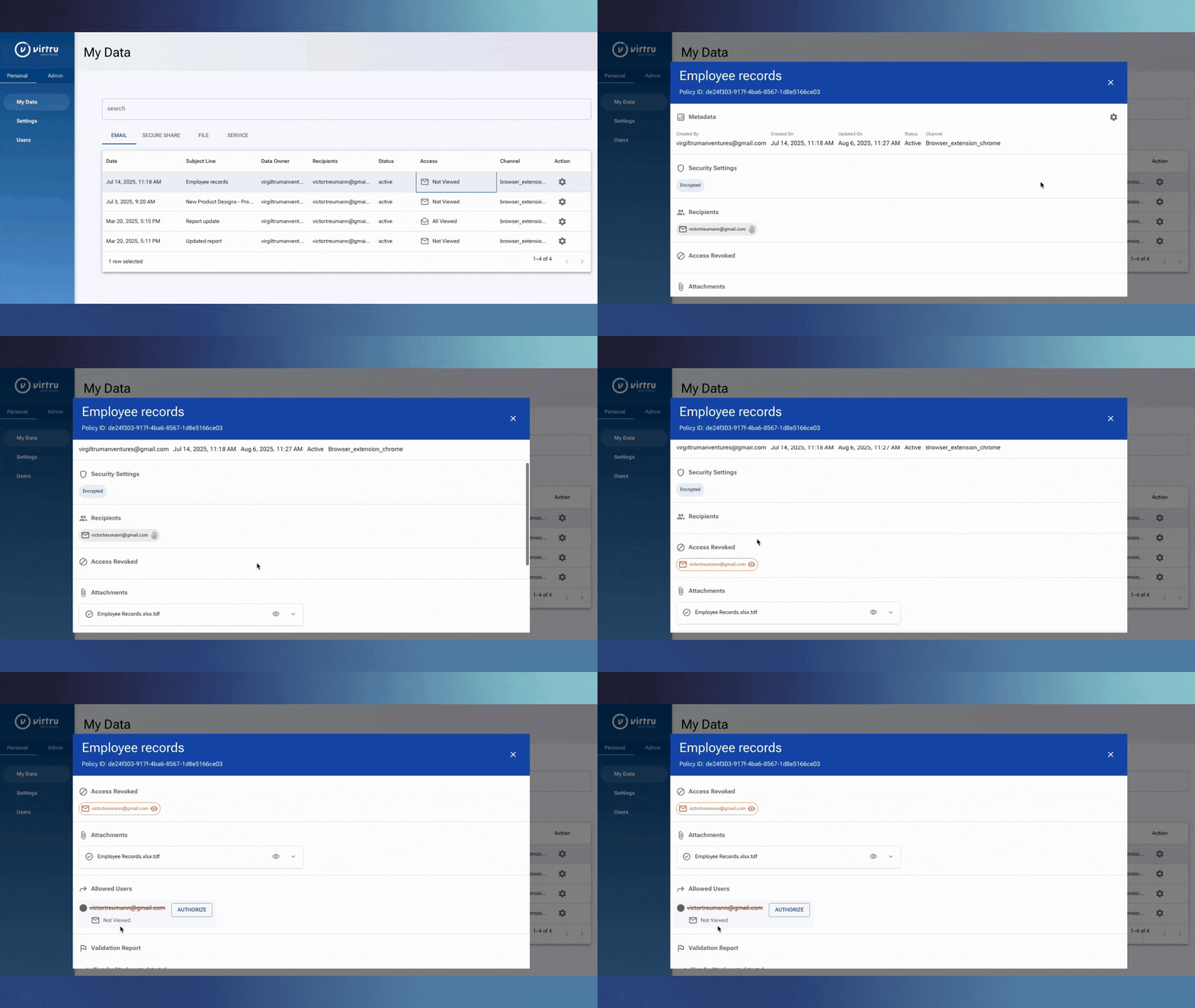
The Virtru Advantage: Virtru provides client-side encryption (as well as server-side encryption with advanced security controls). The data remains encrypted at rest in the recipient's inbox. More importantly, you retain the ability to revoke access at any time. Did you accidentally email a patient list to the wrong vendor? With one click, you can expire the message, rendering it unreadable, even after they’ve opened it.
2. Granular Policy Management for Files and Email
Check Point creates policies based on network rules. Virtru creates policies based on data rules.
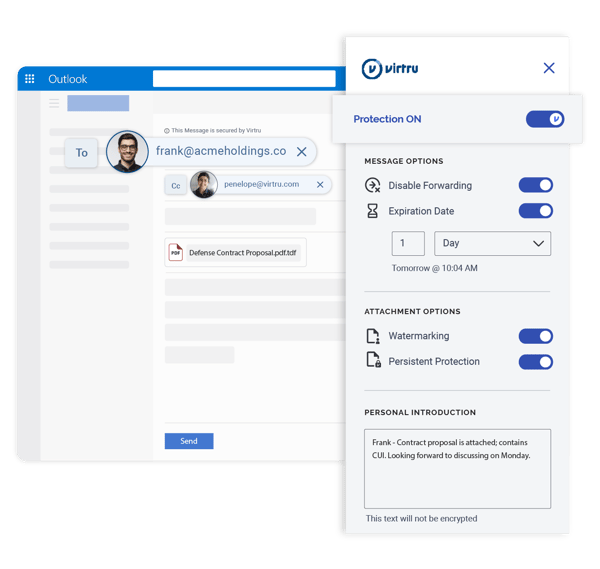
The Virtru Advantage: Virtru lets you apply granular controls to outbound data. You can disable forwarding (so your intellectual property doesn't spread), apply watermarking to encrypted files (to deter leaks), and set expiration dates for sensitive contracts.
3. True Privacy (Even from the Cloud Provider)
Most gateway security solutions require you to give them your encryption keys so they can scan your traffic. This means the vendor (and the cloud provider, like Google or Microsoft) technically has access to your unencrypted data.
The Virtru Advantage: Virtru supports Dual Key Encryption (DKE) and customer-hosted keys with the Virtru Private Keystore. This ensures that only you and your intended recipient can read your data. Not Google, not Microsoft, and not even Virtru. For organizations dealing with ITAR, CJIS, CMMC, or strict HIPAA compliance, this level of data sovereignty is non-negotiable.
Why One Healthcare Company Switched from Check Point to Virtru for Easier Email and File Security
A health insurance organization utilizing Google Workspace faced significant hurdles in securing sensitive plan details and health documents with their previous solution, Check Point. The primary friction point was low user adoption due to a cumbersome workflow; employees were required to manually type “encrypt” in the subject line for every sensitive email, a process that was prone to human error and difficult for administrators to enforce. Furthermore, the existing workflow created a barrier for external customers, who were restricted to plaintext replies and unable to send necessary attachments back securely. The organization desperately needed a HIPAA-compliant solution that was intuitive enough for non-technical staff and seamless for their external clients.
The switch to Virtru for Gmail immediately solved these workflow bottlenecks. Instead of relying on manual subject line triggers, staff could simply toggle protection on or rely on the automated HIPAA Security Rule pack to enforce protection in the background. The IT administrator found particular value in the platform's ease of management and deployment guides, which minimized the training burden previously required. Crucially, Virtru Secure Reader allowed external clients to easily reply with attachments — without needing to create a new password — effectively closing the security loop. Recognizing the immediate fit for their workflow and budget, the organization secured a deal for 150 users, replacing their legacy tool with a system that prioritized both security and usability.
The Verdict: Infrastructure Security Is Incomplete Without Data-Centric Security
This isn't an argument to tear down your firewalls. Infrastructure security is essential for keeping ransomware and hackers out of your network.
Check Point protects the network your data lives on, but Virtru protects the data itself, regardless of where it's located.
If your organization collaborates externally — sharing PII with healthcare providers, schematics with supply chain partners, or financial data with auditors — perimeter defense will only get you so far. You need a solution that allows data to travel freely without compromising security.
Ready to secure your data beyond the perimeter? Request a demo today to see how Virtru complements your existing security stack with Zero Trust data control.
Editorial Team
The editorial team consists of Virtru brand experts, content editors, and vetted field authorities. We ensure quality, accuracy, and integrity through robust editorial oversight, review, and optimization of content from trusted sources, including use of generative AI tools.
View more posts by Editorial TeamSign Up for the Virtru Newsletter
/2026%20BLOG/26-Blog-Protecting%20Patient%20Trust.webp)
FROZEN -- Protecting Patient Trust: How NHS Leaders Can Enforce Policy Automatically
/blog%20-%20FIPS140-3/Virtru-FIPS1403.webp)
FROZEN -- FIPS 140-3 Is the New Standard for Cryptographic Validation. Here Is What That Means for Your Data.
/blog%20-%20rocket.chat/Virtru-rocketchat-blog.webp)
FROZEN -- Security Proven, Not Promised: How RocketChat and Virtru Enable Continuous Access Control
/blog%20-%20security%20triad/triad-blog.webp)
The Modern AI Security Triad
/blog%20-%20zero%20trust%20security,%20journey%20ends%20at%20the%20data/Zero-Trust-Peppo.png)
Zero Trust Security: The Journey Ends at the Data
/blog%20-%20Cymphony/cymphony-ai-workforce.webp)
Cymphony, AI Agents, and the Case for Security That Travels With Data

Nikesh Arora Is Right: It’s Time to Rethink Your Cyber Security Architecture

IBM’s Breach Report Makes the Case for Object-Level Data Security

FROZEN -- Should You Go Against the Flow? Virtru vs. FlowCrypt PGP Encryption

The DoD SAFE Alternative Your Team Will Actually Use